

 Chloe Pugh
Key Takeaways
- Core Definition: A medical virtual assistant is a remote, healthcare-trained professional who handles administrative work for a practice using the practice's own systems.
- Strict Clinical Boundaries: A virtual medical assistant is not a licensed clinician. Diagnosis, prescribing, physical exams, and clinical judgment always stay with the practice's licensed team.
- Mandatory HIPAA Safeguards: Because a remote medical assistant interacts with protected health information (PHI), a written business associate agreement (BAA) is legally required before granting any system access.
- Specialized Role Types: Practices can assign remote support across five distinct tracks: front desk reception, administrative records, insurance and billing coordination, medical scribing, and multilingual patient communication.
- Clear Adoption Triggers: Hiring remote support makes the most sense when a clinic faces persistent phone backlogs, slow insurance eligibility and referral turnarounds, or chronic front-desk staff turnover.
Quick Answer: A medical virtual assistant is a remote, healthcare-trained professional who handles administrative and operational work for a medical practice using the practice's own software systems. They manage tasks like patient scheduling, phone calls, insurance eligibility verification, and medical records coordination, while all clinical care, diagnosis, and medical decisions remain strictly with licensed providers.
What is a medical virtual assistant?
If you run an independent clinic or manage a busy front desk, you have likely heard colleagues talk about bringing on remote help. Knowing what a medical virtual assistant starts with separating general administrative outsourcing from specialized healthcare operations. Unlike a general virtual assistant who might book travel or manage a basic calendar for an e-commerce store, a medical virtual assistant is trained specifically in healthcare workflows, medical terminology, payer processes, and patient privacy rules.
Functionally, a virtual medical assistant acts as an off-site extension of your front and back office. Instead of working from a disconnected third-party platform where patient spreadsheets get exported back and forth, they log directly into your existing electronic health record (EHR), practice management (PM) software, VoIP phone system, and insurance payer portals through encrypted connections. To your patients calling in to book an appointment or check on a referral, the experience feels identical to speaking with someone sitting behind your reception desk.
When evaluating what a medical virtual assistant does, it helps to trace the operational chain of a typical patient visit. A remote medical assistant handles the non-clinical friction points before, during, and after an encounter:
- Pre-visit preparation: Answering inbound calls, booking appointments, updating patient intake packets, and running insurance eligibility checks.
- Encounter support: Documenting real-time clinical notes as a remote scribe while providers focus on the patient.
- Post-visit follow-through: Submitting prior authorization paperwork, tracking outgoing specialist referrals, and routing incoming lab results to the right provider's inbox.
For a complete breakdown of daily workflows, see our guide on the Top 10 Tasks to Outsource to a Healthcare VA.
Medical virtual assistant vs in-office medical assistant
An in-office medical assistant (MA) is trained to work directly with patients in exam rooms, taking vital signs, prepping sterile trays, administering injections under provider supervision, and assisting with minor procedures. A medical virtual assistant works entirely off-site and focuses exclusively on administrative, communication, and documentation workflows.
|
Factor |
Medical Virtual Assistant |
In-Office Medical Assistant |
|
Location |
Remote (works off-site via secure cloud, VPN, or VDI access) |
On-site at the clinic or medical facility |
|
Clinical Tasks (Vitals, Injections) |
None. Strictly prohibited from physical care or clinical triage |
Core duty: vitals, blood draws, EKGs, injections, rooming patients |
|
Admin Tasks |
Non-clinical phone routing, scheduling, intake, insurance checks, records, scribing |
Mix of front-desk check-in, phone calls, and exam room prep |
|
Systems Access |
Role-based remote logins to EHR, PM software, VoIP, and payer portals |
Direct terminal access at reception and exam room workstations |
|
PHI Safeguards |
Covered under a written business associate agreement (BAA) and HIPAA security controls |
Covered directly as a workforce member under the clinic's HIPAA policies |
|
Hiring and Training |
Pre-vetted and trained in healthcare admin; onboarded to clinic SOPs |
Recruited locally; often requires hands-on training in both clinical and admin workflows |
|
Cost Basis |
Predictable service fee; no payroll taxes, benefits, or workspace overhead |
Direct W-2 salary plus payroll taxes, benefits, and physical desk space (the BLS median annual wage for medical assistants was $45,690 in May 2025) |
Types of medical virtual assistant roles
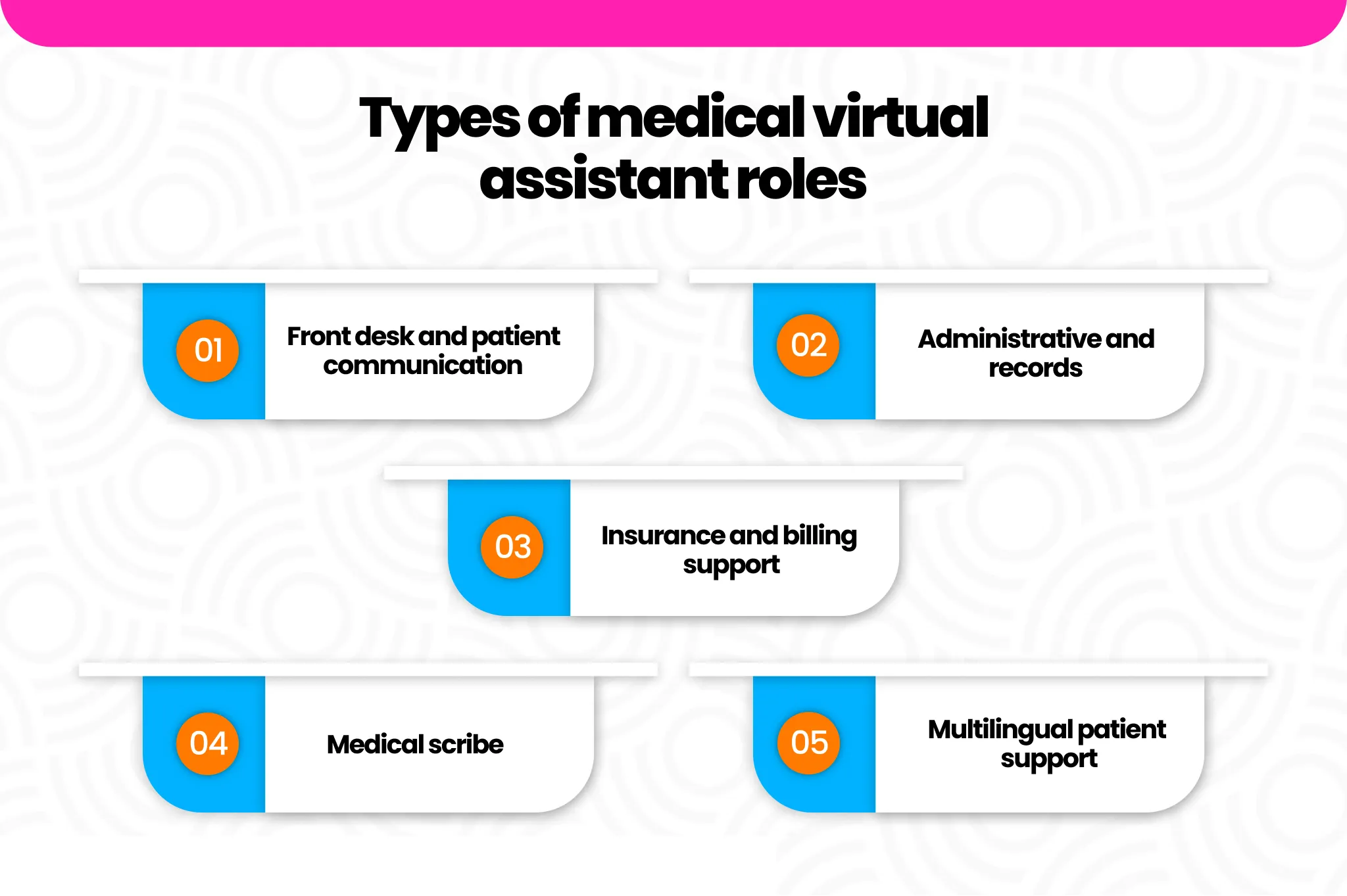
Not every clinic needs an all-purpose generalist. As independent practices scale from one provider to twenty, splitting medical virtual assistant roles by function prevents operational bottlenecks and keeps accountability clear. Most clinics deploy remote staff across five specialized tracks.
Front desk and patient communication
This is the most common starting point for independent practices. A front-desk medical virtual assistant manages inbound and outbound phone queues, schedules new and returning patient visits, sends appointment reminders, and fills cancellation gaps from your waitlist. By absorbing routine phone traffic, they eliminate the long hold times that cause new patients to hang up and call another clinic, while freeing your on-site receptionist to focus on the patients standing right in front of them.
Administrative and records
Back-office medical virtual assistant duties center on keeping patient charts accurate and moving referrals forward. This role handles digital patient intake forms, scans and indexes incoming faxes, requests medical records from outside facilities, and tracks outgoing specialist referrals to confirm patients actually complete their visits. Keeping these administrative loops closed protects both continuity of care and clinic compliance.
Insurance and billing support
Revenue cycle delays often start days before a patient walks through the door. An insurance-focused virtual medical assistant runs batch insurance eligibility verification 48 to 72 hours prior to scheduled appointments, flags inactive policies or high deductibles early, gathers clinical documentation required for prior authorizations, and assists billing teams with claim status follow-ups.
Medical scribe
A virtual medical scribe joins telehealth visits or listens to in-person encounters via secure, HIPAA-compliant audio connections to document patient histories, exam findings, and treatment plans directly into the EHR in real time. Rather than spending two hours every evening finishing charts at home, providers review and sign off on completed notes between visits. To explore how live and asynchronous documentation workflows operate, read our guide on What Does a Virtual Medical Scribe Do?
Multilingual patient support
Clinics serving diverse communities frequently struggle to recruit local bilingual front-desk staff. A multilingual medical virtual assistant bridges communication gaps during scheduling, pre-visit intake, prescription refill requests, and post-visit follow-up calls. Offering native-language support at the first point of contact reduces missed appointments and improves patient comprehension of administrative instructions.
What a medical virtual assistant should not do
Defining clear operational guardrails is just as important as assigning tasks. A medical virtual assistant is not a licensed clinician, nurse, or physician assistant, and treating them as one exposes your practice to severe regulatory and malpractice risks.
Whether you work with an independent contractor or hire a HIPAA-trained medical virtual assistant through a managed service, your clinic must enforce strict boundaries around what remote staff cannot do:
- Diagnose or recommend treatments: A remote assistant cannot interpret symptoms, suggest diagnoses, or tell a patient whether a clinical issue is urgent or minor.
- Perform clinical triage: When a patient calls complaining of chest pain, shortness of breath, or acute symptoms, the assistant must follow a rigid escalation protocol to transfer the call immediately to a licensed nurse or provider, or instruct the patient to seek emergency care.
- Prescribe or authorize medication refills: Even routine refill requests must be queued in the EHR for review and electronic signature by a licensed clinician.
- Sign off on medical charts or orders: While a virtual scribe can draft encounter notes, final review, clinical accuracy verification, and signature sign-off always remain with the licensed provider team.
- Handle physical cash or controlled substance logs: Financial reconciliations involving physical currency and DEA-regulated inventory must remain strictly with authorized on-site personnel.
Benefits for medical practices
Bringing a virtual medical assistant onto your team creates immediate breathing room for both clinicians and on-site staff. By shifting repetitive phone calls, insurance checks, and inbox management off your local desk, your in-office team can deliver calmer, more attentive care to patients in the waiting room while providers reclaim hours lost to after-hours charting.
Because remote staffing avoids local commercial real estate constraints and traditional employee overhead, practices also gain predictable operational capacity without long hiring delays. For a closer look at return on investment and operational benchmarks, read our breakdown of the benefits of hiring a healthcare virtual assistant, or review How Much Do Virtual Assistants Cost? to compare staffing models.
Common use cases by practice type
Different clinical environments hit different administrative bottlenecks. Here is how independent practices typically apply medical virtual assistant support based on their care model:
- Primary care and family medicine: High daily patient volume creates relentless phone traffic for same-day sick visits, lab result callbacks, and routine referral requests. Primary care clinics use remote front-desk and records assistants to keep phone answer rates high and manage chronic care recall lists.
- Specialty clinics (dermatology, orthopedics, cardiology, behavioral health): Specialty practices rely heavily on clean referrals and complex prior authorizations for imaging, procedures, and specialty medications. Dedicated insurance and referral coordinators prevent appointment cancellations caused by missing payer approvals.
- Telehealth and hybrid practices: Practices operating virtually across state lines have zero need for physical reception desks. A remote medical assistant handles digital intake, tech checks, virtual rooming, and follow-up scheduling seamlessly inside cloud-based EHR platforms.
- Multi-location practices (2 to 20 providers): Growing groups often centralize inbound phone lines, insurance verification, and medical records across all branches using a dedicated remote pod, ensuring consistent patient service even when one clinic location experiences local staff absences.
Is a medical virtual assistant HIPAA compliant?
A medical virtual assistant is not automatically compliant simply because they have healthcare experience; HIPAA compliance depends entirely on the legal agreements, technical controls, and daily workflows your practice puts in place.
Under federal HIPAA regulations enforced by the U.S. Department of Health and Human Services (HHS), any vendor or remote staffing partner that creates, receives, maintains, or transmits protected health information (PHI) on behalf of a covered entity is classified as a business associate. Before a remote medical assistant ever logs into your EHR or views a patient's name, your practice must execute a written business associate agreement (BAA) that legally binds the partner to safeguard PHI and report any security incidents.
Beyond the written BAA, compliant practices enforce strict technical safeguards:
- Individual, role-based user accounts: Never share a single login across multiple staff members. Assign the assistant their own unique username with permissions restricted strictly to the modules their role requires.
- Multi-factor authentication (MFA) and encrypted access: Require MFA on all EHR, email, and VoIP logins, alongside encrypted Virtual Private Networks (VPNs) or Virtual Desktop Infrastructure (VDI) so patient data never resides locally on a remote computer.
- Audit trails and device policies: Ensure your EHR logs every record viewed or edited by the assistant, and confirm that remote workstations enforce automatic screen locks, encrypted hard drives, and clean-desk privacy rules.
To evaluate vendor security checklists in detail, review our guide on HIPAA-Compliant Virtual Assistants: What Clinics Need to Know.
Not sure which role fits your front desk? Map your workload with us first to pinpoint where administrative bottlenecks are slowing down your clinic. Get Started
How to tell if your practice needs one
If you are unsure whether your current team is simply having a busy week or facing a structural staffing gap, review these common operational warning signs. Check off any bottlenecks your clinic has experienced over the past 30 days:
Signs Your Practice Needs a Medical VA!
If you check three or more items, offloading one or two targeted workflows to a virtual medical assistant can stabilize daily operations without disrupting your clinical team.
Ready to Take the Pressure Off Your Front Desk?
Whether you need dedicated coverage for inbound phones, insurance eligibility checks, or daily charting support, you can hire a HIPAA-trained medical virtual assistant matched to your clinic's exact workflows and EHR system. If you are still comparing staffing partners across the market, explore our roundup of the Top 10 Virtual Medical Assistant Companies in the USA to weigh your options.
Also Read
Source: Medical Assistants — Occupational Outlook Handbook
Source: Business Associates — HIPAA Guidance for Professionals
Source: Sample Business Associate Agreement Provisions
Source: Virtual assistants can boost efficiency for private practices
Frequently Asked Questions
1. What does a medical virtual assistant do day to day?
2. What is the difference between a medical virtual assistant and a medical assistant?
3. Can a medical virtual assistant access my EHR?
4. What can't a medical virtual assistant do?
5. Is a medical virtual assistant the same as an answering service?
AI Summarize