
Patient Encounter Documentation & Clinical Notes
Prepare encounter details in the format your provider uses for review.

Keep providers focused on the encounter while a virtual medical scribe prepares documentation in your approved workflow. Depending on the scope, the scribe may support encounter notes, chart preparation, structured templates and EHR entries for the provider to review and sign.
Choose real-time or post-visit support based on your specialty, schedule, documentation process and available systems. During consultation, we define what information the scribe receives, what they may enter, how questions are escalated and when the provider reviews the draft.
Security and access
Remote scribing may involve protected health information. Before a scribe participates in your workflow, identify the approved EHR or documentation system, the information required, individual access permissions and the communication method used during or after the visit.
Agree on how patient privacy, authentication, access review and any required contractual safeguards are handled. Your provider remains responsible for reviewing the clinical note and completing final sign-off.

A virtual medical scribe helps prepare documentation for the provider, either during the encounter or from approved information after the visit. The exact tasks depend on your clinical workflow and should be defined before access begins.
Prepare encounter details in the format your provider uses for review.

Organize provider-supplied information into approved note sections and templates.

Enter information only within the permissions and instructions your practice defines.

Route questions and corrections back through an agreed review process.

Work within the approved documentation system using the account and access assigned to the role.

Prepare relevant chart information and flag incomplete documentation for provider review.

Scope the timing of support to how your providers conduct and close visits.

Document preferred terminology, templates and escalation rules during onboarding.
Start with the way your providers document today. Map the encounter types, note templates, EHR steps, visit volume and review requirements before choosing real-time or post-visit support.
A scribe follows the encounter through an approved remote connection and prepares a draft in the designated workflow. The provider reviews, corrects and signs the documentation according to practice policy.
A scribe works from information your practice authorizes after the encounter and prepares the draft for provider review. Agree on the source material, expected turnaround and how missing information is escalated.
Human scribes and AI tools can both help prepare clinical documentation, but they work differently. A human scribe follows an agreed workflow, can ask for clarification through the practice's approved channel and can adapt to a provider's note preferences. An AI tool generates a draft from the information it receives and still needs appropriate review for missing, inaccurate or unsupported details.
Choose based on your encounter types, privacy requirements, EHR process, cost and the level of human support your providers need. Some practices may use both. In every model, the provider should review the final clinical record and complete sign-off.

Human support may fit practices that need a scribe to follow provider-specific templates, handle varied encounter formats and raise documentation questions through a defined workflow. Assess the fit against your actual visit types and the time your providers spend reviewing drafts. A human scribe does not replace clinical judgment or provider accountability.
Define the full path of a clinical note before work begins: what the scribe can see, where they draft, which templates they use, how they ask questions, how corrections are made and who signs the record. The scribe prepares the assigned documentation; the provider reviews and signs the clinical note.

Who you actually get
A scribe who knows one specialty or EHR may still need time to learn another provider's language, note structure and pace. During consultation, tell us which specialties, encounter types, terminology, templates and systems are essential. We will use those requirements to discuss candidate fit and the onboarding work needed before routine documentation begins.
Ask to review the proposed scribe's relevant experience, how training and feedback will be handled, who checks work during ramp-up and what happens if the fit is not right. Put those responsibilities and expectations in the engagement scope rather than assuming that every scribe arrives with the same background.
Request a Virtual Medical Scribe Consultation
The Virtual Mojoe model
The scribe's work needs a clear owner on both sides. During setup, agree on the provider's review process, the contact for questions, how corrections are tracked and who handles scheduling or coverage issues. Ask us to show which supervision and backup arrangements are included in your proposed engagement.

Role and schedule

Review process

Corrections

Escalation

Coverage

Service check-ins
Provider fit
Scribing requirements differ by specialty, visit type and provider. Tell us what a typical day looks like: the terms your team uses, note structure, encounter volume, EHR workflow and whether support is needed during or after the visit. That gives you a practical basis for evaluating fit.
We use these requirements to discuss a realistic role scope and onboarding plan for your practice.
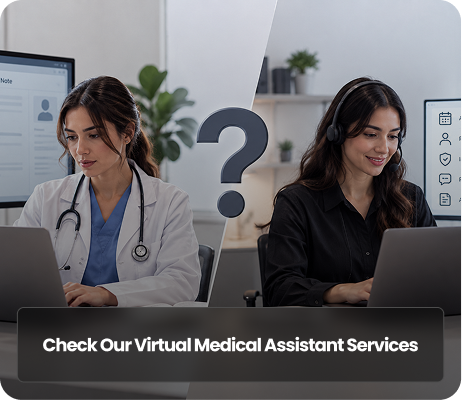
Choose the right role
Choose scribing when the main bottleneck is provider-directed encounter notes, chart preparation and clinical documentation review.
Choose administrative support when the main bottleneck is scheduling, calls, insurance eligibility, referrals, records coordination or patient follow-up.
Explore Virtual Medical Assistant ServicesPricing
A useful scribe quote reflects your documentation workload and the support included in the engagement. Ask for the expected coverage hours, encounter volume, real-time or post-visit model, EHR setup, review process and any backup arrangements. The proposal should also explain billing, onboarding, changes to scope and cancellation terms before you commit.
We will scope the work and explain the applicable price and terms.
A virtual medical scribe helps document patient encounters, prepare clinical notes and update the EHR using your approved templates and workflows. Your provider reviews and signs off on the documentation.
Yes. A real-time scribe documents during the encounter through your approved remote workflow. Post-visit documentation can also be scoped around your practice.
Yes. We define your approved EHR, access permissions, note templates and documentation processes before the engagement begins.
A scribe focuses on clinical documentation and charting. A virtual medical assistant supports administrative work such as scheduling, calls, insurance verification and practice coordination.
No. The provider remains responsible for reviewing the clinical documentation, making corrections and completing final sign-off.
Remote scribing must follow applicable HIPAA requirements. Approved systems, controlled access, minimum-necessary permissions and appropriate agreements are defined before PHI access begins.
Start with a consultation. We map your documentation workload, specialty, EHR, coverage and provider preferences, then define the role and onboarding workflow.
Build the right documentation workflow
Tell us how your providers document today, where notes slow them down and which EHR steps need support. We will discuss a real-time or post-visit model, the responsibilities assigned to the scribe and the review process your practice requires.
Discuss My Scribe Workflow
