 Chloe Pugh
Key Takeaways
- The scribe documents; the provider decides: A virtual medical scribe documents the visit in your EHR — live or after it — while the provider keeps every clinical decision, review, and signature.
- The scribe prepares; the provider signs: The scribe prepares and drafts; the provider decides and signs. Orders are pended for review, never signed by the scribe.
- Clear limits protect the record: A scribe never diagnoses, signs notes, logs in under a physician's credentials, or gives patients clinical advice.
- Match the model to your bottleneck: Real-time scribing cuts after-hours charting fastest; post-visit scribing fits high-velocity clinics and providers who already dictate.
- Set scope before day one: Set scope before day one: the scribe's own EHR login, BAA, HIPAA training, templates, turnaround time, and sign-off steps.
A virtual medical scribe is a trained documentation specialist who joins the visit remotely, live or after it, and writes the encounter note in your EHR using your templates. The provider still makes every clinical decision, reviews the note, and signs it.
What does a virtual medical scribe do?
If you are asking what a virtual medical scribe does, the short version is this: they take documentation off your plate. They listen to the visit, or work from a recording or your dictation, and turn what was said into a clean note inside your EHR/EMR. You stay focused on the patient. The scribe handles the typing.
The difference from an in-room scribe is location. A remote scribe connects by secure audio or video instead of standing in the exam room, which means no extra chair, no extra salary overhead for space, and coverage that is not tied to your building. If you want help with pricing and vendor selection, our complete guide to virtual medical scribe services covers that. This post sticks to the role itself.
Quick answer: A virtual medical scribe joins the visit remotely — live or after it — and writes the encounter note in your EHR using your templates. The provider still makes every clinical decision, reviews the note, and signs it.
Core duties, task by task
Here is the virtual scribe job description in plain terms. These are the virtual medical scribe duties most practices assign, along with who keeps responsibility at each step. Think of it as the working list of remote medical scribe responsibilities.
| Task | What the scribe does | What the provider still owns |
|---|---|---|
| Pre-visit chart prep | Reviews the schedule, pulls recent labs, imaging and prior notes, and sets up the visit template | Deciding what matters clinically for each patient |
| HPI, review of systems and exam findings | Records what the patient and provider say, in the provider's preferred style | Confirming the history and exam are accurate |
| Assessment and plan | Documents the plan exactly as the provider states it | Every diagnosis and treatment decision |
| Orders and referrals | Prepares them as pended orders for review | Reviewing, correcting and signing them |
| After-visit chart completion | Finishes the SOAP note, fills gaps and flags open questions | Final review and signature |
| Corrections from feedback | Updates templates and phrasing as the provider gives notes | Setting the standard for how notes should read |
Notice the pattern. The scribe prepares and drafts. The provider decides and signs. If you want to see what that handoff does for your day, read the benefits of virtual medical scribes for physicians.
What a virtual scribe does not do
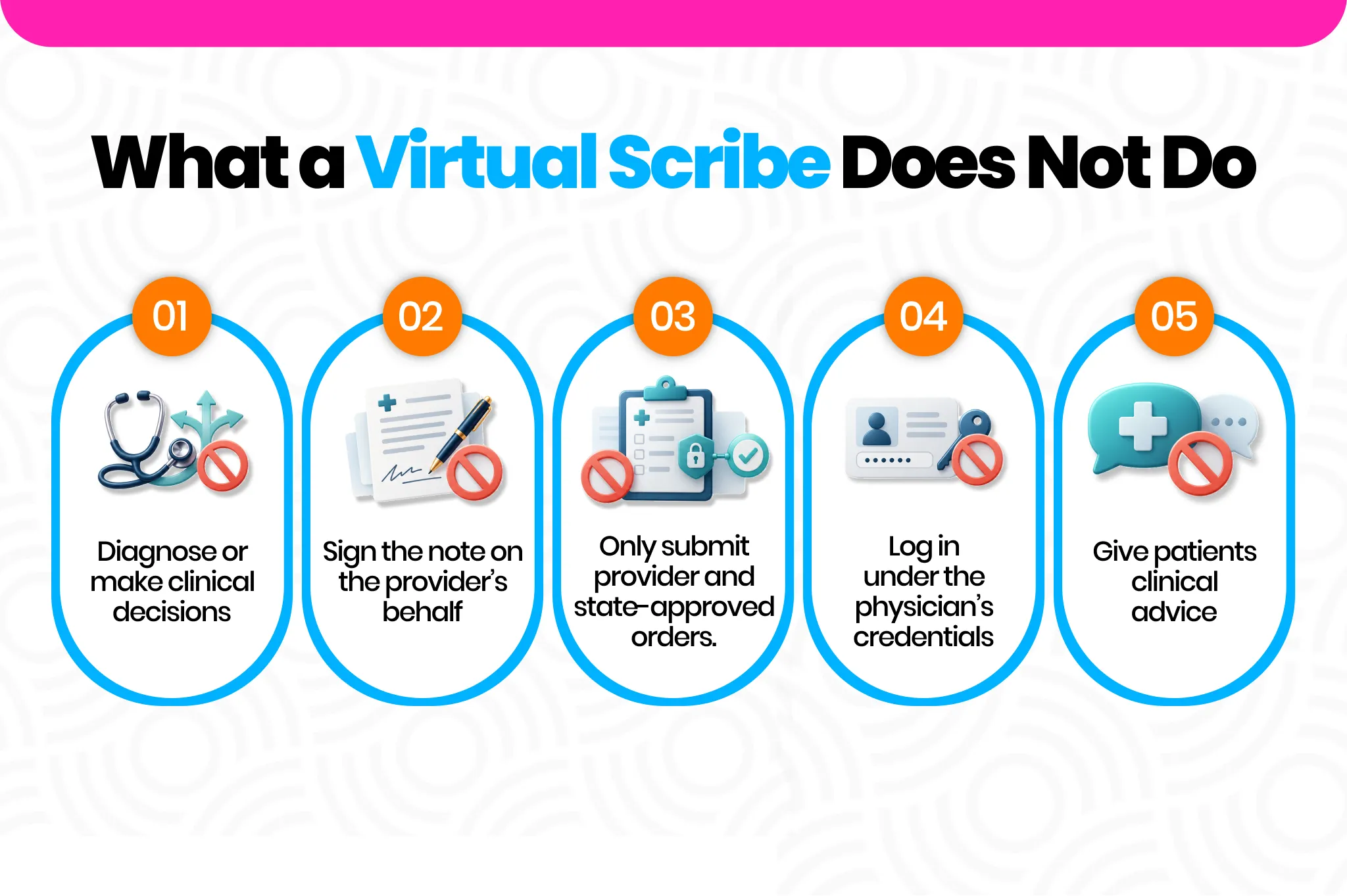
Knowing what a medical scribe doesn't do matters as much as knowing the duties. It protects your license and your billing. A scribe should never:
- Diagnose or make clinical decisions
- Sign the note on the provider's behalf
- Submit orders unless the provider has authorized it and state rules allow it
- Log in under the physician's credentials
- Give patients clinical advice
Several of these come straight from the rulebooks. The CMS Program Integrity Manual does not require the scribe to sign the note. What counts is the signature of the treating provider, who is responsible for what the record says. The AMA's guidance says scribes may enter orders as directed, but the physician owns accuracy, signs the order, and cannot hand off medical decision-making. State rules still apply on top of that.
The Joint Commission has also changed course. It no longer bans scribes from entering orders. Staff who are not authorized to enter orders should pend them for the provider instead. The same body flags a scribe using a physician's login as a risk, since it blurs who did what in the record.
Access is the other half of this. A scribe who works inside your EHR needs their own credentials, a signed business associate agreement (BAA), and HIPAA training. We cover that in more depth in our post on HIPAA-compliant virtual assistants.
Real-time vs post-visit scribing
There are two common models, and the choice changes your day. Here is how real-time vs post-visit scribing compares.
Real-time scribing. The scribe joins the visit live and writes the note as the conversation happens. Notes are often ready for review soon after the patient leaves. Choose this if after-hours charting is your biggest pain. Real-time cuts "pajama time" fastest because the note is nearly finished when the visit ends.
Post-visit scribing. The scribe works from a recording or your dictation after the encounter and returns the note for review. Choose this if you run a high-velocity clinic, or you already dictate between patients and want someone to shape that into a finished note.
Neither model is better in general. Match the model to where your bottleneck sits. Our virtual medical scribe services support both.
A scribed clinic day
This is an illustrative walkthrough, not a measured result. Your own schedule will look different.
Morning. Before the first patient, the scribe does chart prep: reading yesterday's results, pulling relevant history, and loading the right template for each visit type.
Live visits. The scribe joins each visit remotely and drafts the HPI, review of systems and exam findings as they are spoken. When the provider states the plan, the scribe captures it and pends any orders or referrals.
Between visits. The scribe sends short queries, such as a missing medication dose or an unclear laterality, so the question gets answered while the visit is still fresh.
End of day. Everything is handed off for sign-off. The provider reviews each note, fixes anything that needs fixing, releases the pended orders, and signs. Corrections feed back into templates for tomorrow.
Scribe vs transcriptionist vs virtual medical assistant vs AI scribe
These roles get mixed up constantly. They solve different problems.
| Who | Works when | Output | Who reviews |
|---|---|---|---|
| Virtual medical scribe | Live or after the visit | A structured encounter note in your EHR | The treating provider |
| Medical transcriptionist | After the visit, from dictation | A typed document from audio | The provider, usually after upload |
| Virtual medical assistant | Across the workday | Scheduling, intake, follow-ups, admin tasks | The practice manager or provider |
| Ambient AI scribe | Live, automatically | An automated draft note | The provider, often with heavier editing |
A transcriptionist types what you say. A scribe organizes it into a note that fits your template. A virtual medical assistant handles the wider admin load that is not charting. An ambient AI scribe produces a draft without a human in the loop, so the provider carries more of the review burden. Many practices choose a human scribe when accuracy and context matter most, and a VMA when the bottleneck is front-office work rather than notes.
Skills to expect
A capable scribe brings a working grip on medical terminology, EHR navigation, specialty templates, HIPAA rules, and the basics of computerized order entry. The Joint Commission lists these as minimum training areas for scribes, so they are a fair baseline when you vet anyone. Specialty fluency is the one that shows up fastest. A scribe who knows cardiology phrasing will need far less correction than one learning it on your time.
If you want a sense of what good scribing returns, a 2024 JAMA Network Open study of virtual scribes found 5.6 fewer EHR minutes per appointment. Our benefits post covers the rest.
Scope the role before day one
The smoothest starts settle these points in advance:
- EHR access and permissions, with the scribe's own login
- Specialty terminology and common abbreviations
- Turnaround time for notes
- Note templates for each visit type
- Provider preferences, such as phrasing and what to leave out
- Review and sign-off steps
Write these down. It takes an hour and saves weeks of rework.
Also read
Source: Virtual Mojoe — Virtual Medical Scribe Services
Source: Virtual Mojoe — HIPAA-Compliant Virtual Assistants for Clinics
Frequently Asked Questions
1. Can a virtual medical scribe enter orders?
2. Does a scribe have to sign the note for Medicare?
3. Is a virtual scribe the same as a medical transcriptionist?
4. Can a virtual scribe document telehealth visits?
5. Do patients need to know a remote scribe is listening?
6. Can one virtual scribe cover more than one provider?
AI Summarize