

What Does a Virtual Medical Secretary Do? Duties, Skills & Role in a Medical Practice
Updated September 30, 2026
A virtual medical secretary is a human remote healthcare administrative professional who supports doctors, clinics, and medical practices with the non-clinical work that keeps the day organized. Typical responsibilities include appointment scheduling, patient calls and messages, provider calendar management, referrals, correspondence, medical records, EHR administration, insurance-related coordination, and administrative follow-up.
Quick answer: A virtual medical secretary manages remote secretarial and administrative workflows for a medical practice. The role commonly covers scheduling, phone and inbox management, patient communication, referrals, correspondence, records, administrative EHR work, insurance coordination, and follow-up. A virtual medical secretary does not independently diagnose, triage, prescribe, make treatment decisions, or replace licensed clinical staff.
What Is a Virtual Medical Secretary?
A virtual medical secretary performs the administrative and secretarial work of a medical office remotely. Instead of sitting at the physical front desk or inside a provider's office, the secretary works through approved phone systems, email, scheduling software, electronic health records, practice-management platforms, and other digital tools used by the practice.
The role sits between traditional medical secretarial work and modern remote healthcare staffing. It is more healthcare-specific than a general virtual assistant because the secretary must understand medical terminology, patient communication, provider schedules, confidentiality, referrals, records, and the way administrative tasks move through a clinical environment.
The exact job description varies by practice. A specialist may need heavy calendar, referral, correspondence and provider support. A primary care clinic may need more patient calls, scheduling, records and insurance administration. A telehealth practice may need appointment coordination, portal messages and remote intake administration.
What Does a Virtual Medical Secretary Do Day to Day?
The role is easiest to understand as a set of recurring workflows rather than a random list of tasks. A well-scoped secretary owns clearly defined administrative queues, completes routine work inside approved systems, and escalates clinical or exceptional issues to the appropriate team member.
| Workflow | Typical Responsibilities | Common Systems | Escalate When |
|---|---|---|---|
| Scheduling | Book, reschedule, confirm and cancel appointments; manage provider calendars and waitlists | EHR, practice-management software, scheduling tools | Clinical urgency or provider approval is required |
| Patient Communication | Answer calls, log messages, respond to routine administrative questions and route requests | VoIP, secure messaging, patient portal, shared inbox | A patient asks for medical advice or reports symptoms |
| Referrals | Log referrals, request missing documents, coordinate records and track administrative status | EHR, fax, referral portals, secure email | Clinical appropriateness or urgency must be determined |
| Records & Documents | Organize incoming records, upload approved documents, track requests and route correspondence | EHR, document-management tools, secure fax | Disclosure or authorization falls outside standard procedure |
| Insurance Administration | Support eligibility checks, collect administrative information and track authorization status | Payer portals, EHR, practice-management software | Complex coverage, coding or medical-necessity judgment is required |
The exact responsibilities depend on the secretary's training, the practice's policies, applicable law, and the systems and permissions assigned to the role.
Core Responsibilities of a Virtual Medical Secretary
1. Appointment Scheduling and Provider Calendar Management
Scheduling is one of the most common responsibilities because the secretary often becomes the administrative link between patients and the provider's calendar.
- Book new and returning patient appointments
- Reschedule and cancel visits
- Send confirmations and reminders
- Maintain provider availability
- Coordinate telehealth appointments
- Manage waitlists and open appointment slots according to practice rules
The secretary should follow written scheduling protocols rather than independently deciding how urgent a patient's medical condition is. Clinical urgency should be escalated.
For a deeper workflow breakdown, see how a virtual assistant manages appointment scheduling for medical practices.
2. Patient Calls, Messages and Routine Communication
A virtual medical secretary can act as a consistent administrative communication point for the practice. This may include incoming calls, voicemail, portal messages, email and approved outbound follow-up.
- Answer routine incoming calls
- Take accurate messages
- Route requests to the correct staff member
- Provide approved administrative information
- Track pending callbacks
- Communicate appointment and paperwork requirements
A secretary can collect and route information, but should not independently diagnose, triage symptoms, recommend treatment or answer clinical questions outside an approved administrative script.
3. Referral Coordination
Referrals can involve several administrative steps across the referring practice, receiving office, patient, insurer and medical-records workflow. A virtual medical secretary can keep that process organized.
- Receive and log incoming or outgoing referrals
- Confirm that required administrative information is present
- Request missing records or forms
- Send approved records to receiving offices
- Track referral status
- Follow up on incomplete administrative steps
Decisions about whether a referral is medically appropriate, clinically urgent or requires a specific specialist remain with the appropriate healthcare professional.
4. Provider Inbox, Email and Correspondence Management
Medical secretarial work often includes managing the administrative communication surrounding a provider. A virtual secretary can organize those channels so important requests are not buried inside an overflowing inbox.
- Sort administrative email and inbox items
- Flag high-priority messages using practice rules
- Prepare or format routine correspondence
- Track letters awaiting provider review
- Coordinate communication with hospitals, referring practices and other offices
- Maintain administrative follow-up lists
Where the practice uses dictated correspondence, a trained secretary may also format or transcribe approved correspondence for provider review. That is different from a virtual medical scribe, whose primary role is encounter documentation and provider charting workflows.
5. Medical Records and Document Administration
Medical practices receive a constant flow of records, forms, reports, referral documents and patient paperwork. A secretary can manage the administrative handling of those documents inside the practice's approved process.
- Track incoming and outgoing records requests
- Upload and index approved documents
- Maintain document naming and filing conventions
- Monitor incomplete records requests
- Route documents to the appropriate queue
- Prepare files for review or follow-up
The secretary should not decide independently whether unusual disclosures are legally appropriate. Requests that fall outside established procedures should be escalated.
6. EHR and Practice-Management Administration
Remote medical secretaries can work inside an approved EHR or practice-management system when they have the appropriate access, training and role definition.
- Update demographic and administrative fields
- Process administrative work queues
- Upload records and correspondence
- Maintain scheduling and contact information
- Route tasks to providers or staff
- Track incomplete administrative items
The role should not quietly expand into independent clinical documentation or provider sign-off. If charting is the main bottleneck, a dedicated medical scribe is the clearer role.
7. Insurance Eligibility and Authorization Administration
Depending on the practice, a virtual medical secretary may support the administrative side of insurance verification and prior authorization.
- Check eligibility through approved payer sources
- Document available coverage information
- Confirm whether authorization may be required
- Prepare administrative forms
- Collect approved supporting documents
- Track authorization status and payer follow-up
Clinical justification, medical necessity, coding decisions and complex payer disputes should remain with appropriately trained or licensed staff.
See our guide to insurance verification and eligibility support for a deeper workflow breakdown.
8. Billing Coordination and Administrative Follow-Up
A medical secretary may assist around the billing process without becoming the practice's medical coder or revenue-cycle specialist.
- Collect missing administrative information
- Route billing questions to the appropriate team
- Track patient statements or account follow-up
- Coordinate documentation requested by the billing team
- Support routine payment or claim-status workflows when trained
When claims, denials, coding, payment posting or accounts receivable become the primary responsibility, the practice may need a dedicated medical billing virtual assistant or billing specialist instead.
9. Patient Reminders and Administrative Follow-Up
A virtual secretary can help keep routine administrative follow-up from disappearing into an overloaded front-desk queue.
- Send appointment reminders
- Follow up on incomplete forms
- Track administrative callbacks
- Remind patients about approved next steps
- Monitor outstanding referral or records items
Clinical care instructions, symptom assessment and treatment decisions should be routed to licensed staff.
10. Daily Practice and Provider Coordination
The secretary's broader value is often coordination. Instead of completing isolated tasks, the role can connect patient requests, provider calendars, outside offices, documents and internal task queues.
For example, a secretary may receive a referral, request missing records, schedule the appointment, confirm administrative requirements, update the practice system and place the next follow-up task in the correct queue. That is more valuable than treating each step as unrelated VA work.
How a Virtual Medical Secretary Fits With Other Healthcare Support Roles
Healthcare support titles overlap, and different employers sometimes use them differently. The workflow matters more than the label. Still, these role boundaries are useful when deciding what kind of remote support a practice actually needs.
| Role | Primary Focus | Typical Responsibilities | Best When |
|---|---|---|---|
| Virtual Medical Secretary | Provider and practice administration | Scheduling, calls, correspondence, referrals, records, inbox and administrative coordination | A doctor or practice needs broad secretarial ownership |
| Virtual Medical Receptionist | Front desk and patient access | Calls, appointments, messages, intake and reminders | The main bottleneck is front-desk volume |
| Virtual Medical Assistant | Broader healthcare administration | Scheduling, patient communication, insurance, records, referrals and back-office workflows | Several administrative workflows need one broader role |
| Virtual Medical Scribe | Provider documentation | Encounter documentation, chart preparation and approved EHR documentation workflows | Charting is the main problem |
| Medical Billing VA | Revenue-cycle administration | Claims, A/R, payment posting, denials and billing workflows depending on training | Billing is the dominant workload |
A single person may support adjacent workflows when properly trained, but the job description should still identify which responsibilities they own and which require specialist or clinical escalation.
What Should a Virtual Medical Secretary Not Do?
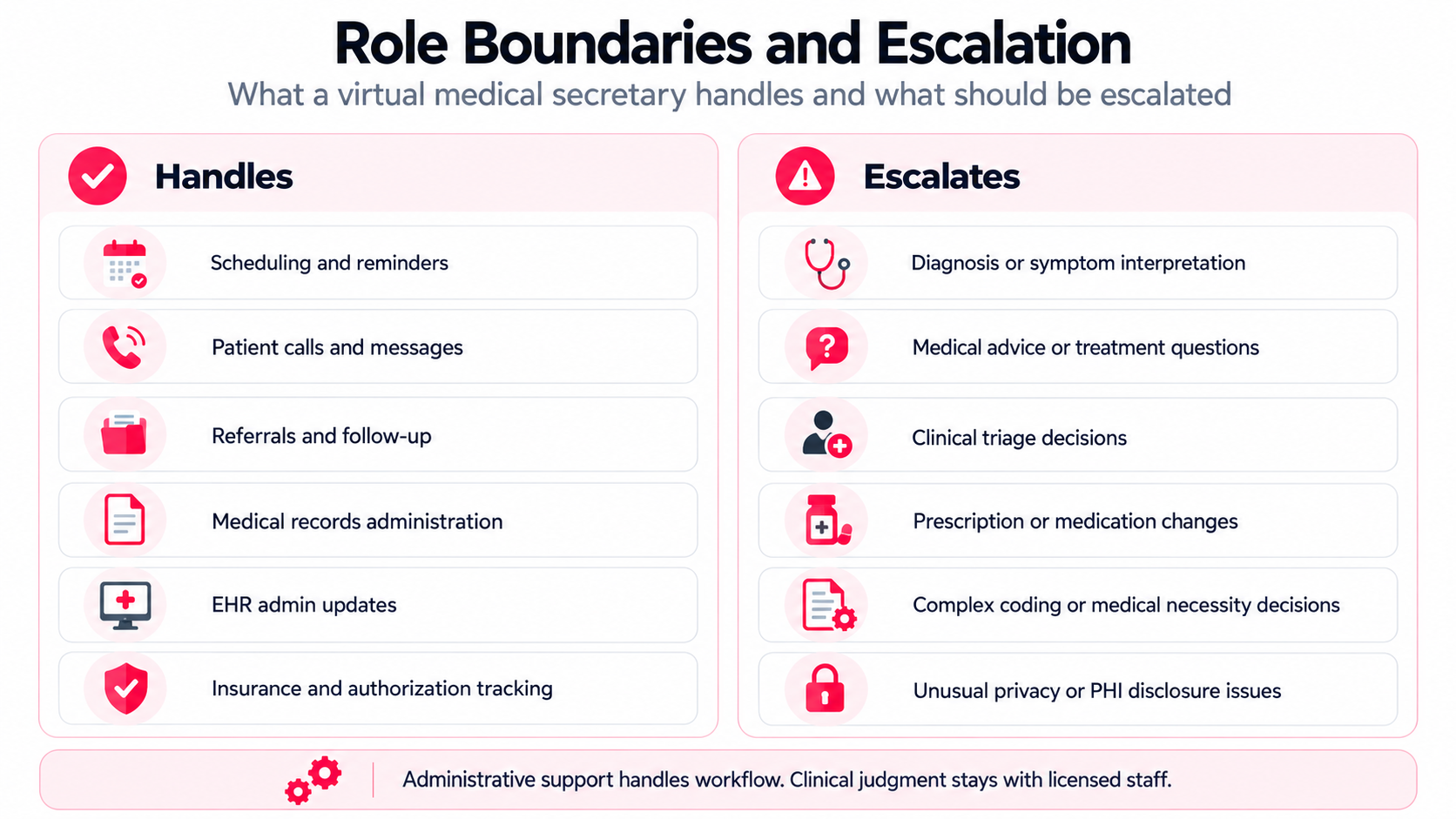
Remote work does not change the boundary between administrative support and clinical judgment. A virtual medical secretary should have a clear escalation path for requests that fall outside the role.
- Diagnose a patient or interpret symptoms independently
- Provide medical advice or treatment recommendations
- Prescribe, approve or change medication
- Make independent clinical-triage decisions
- Interpret laboratory or imaging results for patients
- Make medical-necessity determinations
- Perform independent coding decisions without appropriate expertise and authorization
- Sign clinical documentation on behalf of a provider
- Access patient information unrelated to assigned responsibilities
- Use unapproved personal systems to store or transmit PHI
What Skills Should a Virtual Medical Secretary Have?
A strong medical secretary needs more than general administrative ability. The role combines healthcare context, communication, organization and secure system use.
Enough healthcare vocabulary to route messages, referrals, documents and administrative requests accurately.
Clear, calm and professional communication because the secretary often becomes a visible extension of the practice.
Attention to appointment types, visit lengths, provider availability and escalation rules.
Consistent attention to names, dates, contact information, records requests and administrative notes.
Comfort with EHRs, practice-management software, secure messaging, phone systems and payer portals.
Understanding why PHI access is restricted and when privacy or security issues require escalation.
Ability to manage recurring queues, due dates, handoffs and follow-up rather than waiting for isolated tasks.
Knowing when a request leaves the administrative workflow and needs clinical, billing, privacy or management review.
If you are researching the role from a career perspective rather than hiring for a practice, see how to become a virtual medical secretary.
How Does a Virtual Medical Secretary Work Remotely?
A virtual secretary works as an extension of the practice through approved digital systems. A typical setup may include a cloud phone system, practice email or shared inbox, scheduling software, EHR or practice-management access, secure messaging, fax or document tools and payer portals.
The practice should define which queues the secretary owns, what coverage hours apply, which systems are required, who receives escalations and how work is measured. A remote setup becomes much easier to manage when ownership is explicit.
Good remote workflow
- Dedicated practice credentials
- Role-based system permissions
- Written SOPs and call-handling rules
- Defined escalation contacts
- Shared task queues or dashboards
- Regular workflow review
Poor remote workflow
- Shared passwords
- Unrestricted chart access
- Patient information sent through personal tools
- No distinction between administrative and clinical requests
- No owner for incomplete tasks
- No offboarding or access-removal process
See our separate guide on how medical secretaries work remotely for more detail on the operating model.
HIPAA, PHI and a Virtual Medical Secretary
A medical secretary may need access to protected health information to perform scheduling, records, insurance, referral or communication workflows. HIPAA compliance therefore depends on the complete arrangement, not simply on calling the worker "HIPAA compliant."
HHS explains that covered entities generally must make reasonable efforts to limit the use, disclosure and requests for protected health information to the minimum necessary for the intended purpose. HHS also explains that when a covered entity uses a business associate to perform services involving PHI, an appropriate written business associate contract is generally required.
Official guidance: HHS Minimum Necessary Requirement · HHS Business Associate Contracts
When Is a Virtual Medical Secretary the Right Hire?
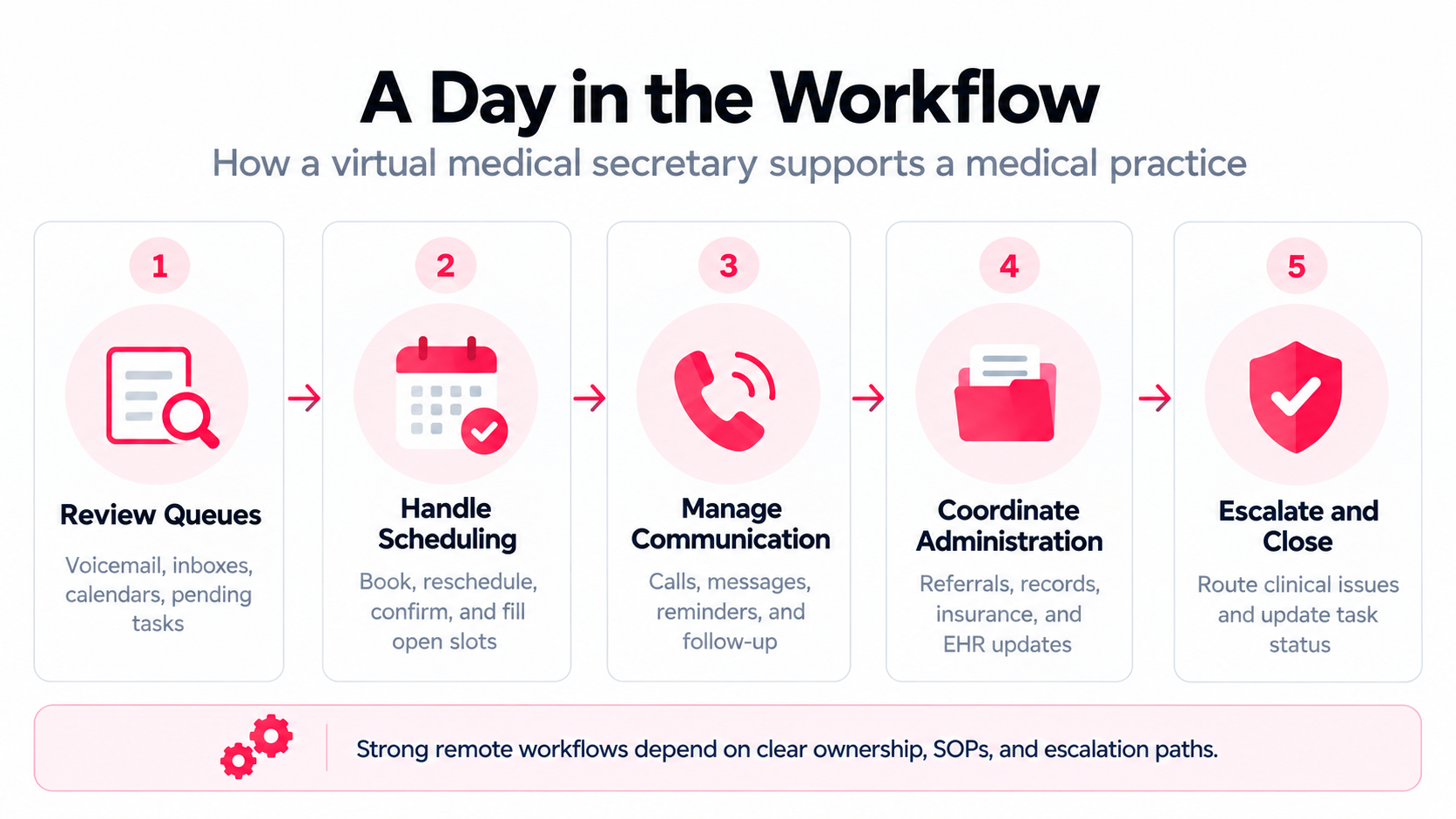
What Does a Typical Day Look Like?
The exact schedule varies, but a well-structured role usually revolves around recurring queues rather than constant ad hoc requests.
Review voicemail, inboxes, appointment changes, outstanding referrals and priority administrative tasks.
Handle calls, scheduling changes, confirmations, records requests and messages that need routing.
Work referral queues, correspondence, insurance administration, document organization and provider follow-up lists.
Complete follow-ups, update task status, fill appointment gaps where appropriate and prepare unresolved items for escalation.
Confirm pending items have an owner, update the task system and flag anything requiring provider or manager review.
Periodically review workload, access, task ownership and whether responsibilities need to change.
Remote and In-House Medical Secretarial Work
The fundamental administrative role can be similar, but the operating model is different. An in-house secretary can perform physical office tasks and interact with patients or staff on site. A virtual secretary is best suited to work that can be completed through phone, EHR, email, scheduling, portals and other approved remote systems.
| Area | Virtual Medical Secretary | In-House Medical Secretary |
|---|---|---|
| Location | Works remotely through approved digital systems | Works physically inside the practice |
| Patient interaction | Phone, portal, email, SMS or other approved remote channels | Remote channels plus face-to-face interaction |
| Physical office work | Limited to tasks that can be completed remotely | Can handle physical documents, visitors and on-site logistics |
| Systems | Requires secure remote access and defined permissions | Uses the same systems from the office environment |
| Best fit | Digitized practices with clearly defined remote workflows | Practices that need significant physical front-office coverage |
Final Takeaway
A virtual medical secretary is not simply a general VA working for a doctor. The role is a remote healthcare administrative position built around provider support, patient communication, scheduling, referrals, correspondence, records and the daily coordination that keeps a medical practice organized.
The strongest setup starts with a defined job description. Decide which queues the secretary owns, what systems are required, what information they need, which requests must be escalated and how the practice will review performance.
If the main bottleneck is front-desk calls, use a receptionist-focused role. If charting is the problem, use a medical scribe. If the work spans broader healthcare administration, a virtual medical assistant may be more appropriate. The title matters less than matching the role to the workflow.
If you are deciding whether this role makes financial and operational sense for your practice, see whether hiring a virtual medical secretary is worth it.
Frequently Asked Questions
What does a virtual medical secretary do?
A virtual medical secretary remotely manages non-clinical administrative workflows for a medical practice, including scheduling, patient communication, provider calendars, referrals, correspondence, records, EHR administration, insurance-related coordination and routine follow-up.
Is a virtual medical secretary the same as a virtual medical receptionist?
Not exactly. A virtual medical receptionist is usually focused on front-desk work such as calls, appointments, messages and intake. A virtual medical secretary can have a broader provider-administration role that also includes correspondence, referrals, records, inbox management and practice coordination.
Is a virtual medical secretary the same as a virtual medical assistant?
The roles can overlap. A virtual medical assistant is often the broader term for remote healthcare administrative support, while a virtual medical secretary is more closely associated with secretarial, provider-support, correspondence and coordination workflows.
Can a virtual medical secretary work inside an EHR?
Yes, when the practice authorizes access and the secretary is trained for the approved workflow. Permissions should be limited to the systems, functions and information required for the assigned responsibilities.
Can a virtual medical secretary handle insurance verification?
A secretary can support administrative insurance workflows such as eligibility checks, documenting available benefit information and tracking prior authorization status when those tasks are included in the role.
Can a virtual medical secretary do medical billing?
A secretary may support billing administration, but if claims, coding, denials, payment posting or accounts receivable are the primary responsibilities, a dedicated medical billing professional is usually the clearer role.
Can a virtual medical secretary work from home?
Yes. The role can be performed remotely when the practice has appropriate systems, secure access, clear procedures, defined responsibilities and reliable communication channels.
Does a virtual medical secretary need HIPAA training?
Anyone handling PHI in a HIPAA-regulated workflow needs appropriate privacy and security awareness for the role. The practice should also determine the applicable relationship, access requirements, safeguards and whether a Business Associate Agreement is required.
What skills should a virtual medical secretary have?
Important skills include medical terminology, professional patient communication, scheduling, accurate documentation, organization, healthcare-system familiarity, privacy awareness, task ownership and knowing when an issue requires escalation.
Who should hire a virtual medical secretary?
The role is a good fit for doctors, specialists, clinics and medical practices with recurring administrative work such as scheduling, calls, referrals, records, correspondence and provider coordination that can be completed remotely.
AI Summarize