

 Chloe pugh
A virtual medical receptionist is a trained remote professional who handles the patient-facing front desk work of a medical practice. The receptionist can answer patient calls, schedule and reschedule appointments, collect basic intake information, send reminders, take messages, and route requests to the correct person while working inside the practice's approved phone, scheduling, and record systems.
The role is simple in principle: the receptionist receives a patient request, follows the practice's rules, completes the front-desk task when it is within scope, records the outcome, and escalates anything clinical or outside the approved workflow.
Quick answer: A virtual medical receptionist works as a remote extension of the medical front desk. The practice gives the receptionist approved access to its phone system, appointment calendar, practice management system, and, when required, limited EHR or EMR access. The receptionist then handles routine patient communication and scheduling according to the practice's scripts, scheduling rules, privacy requirements, and escalation procedures.
What Is a Virtual Medical Receptionist?
A virtual medical receptionist is a remote healthcare administrative professional who manages front-desk communication for a medical practice. The role is primarily patient-facing and non-clinical.
The receptionist may answer the same phone number patients already use, work from the same appointment schedule as the in-office team, and update the same approved systems. The main difference is location. An in-office receptionist works at the physical front desk, while a virtual medical receptionist performs approved front-desk tasks remotely.
In this guide, virtual medical receptionist refers to a trained human receptionist. An automated phone menu, AI voice agent, or basic answering service can also handle parts of patient communication, but those tools operate differently and should not be treated as the same service.
A virtual medical receptionist is also narrower than a general virtual medical assistant. A medical assistant may support a broader mix of administrative, insurance, billing, records, or coordination tasks. A receptionist is centered on the front desk: calls, scheduling, intake, messages, and patient communication.
How Does a Virtual Medical Receptionist Work?
A virtual medical receptionist follows a defined front-desk workflow from the moment a patient contacts the practice until the request is completed or handed to the correct staff member.
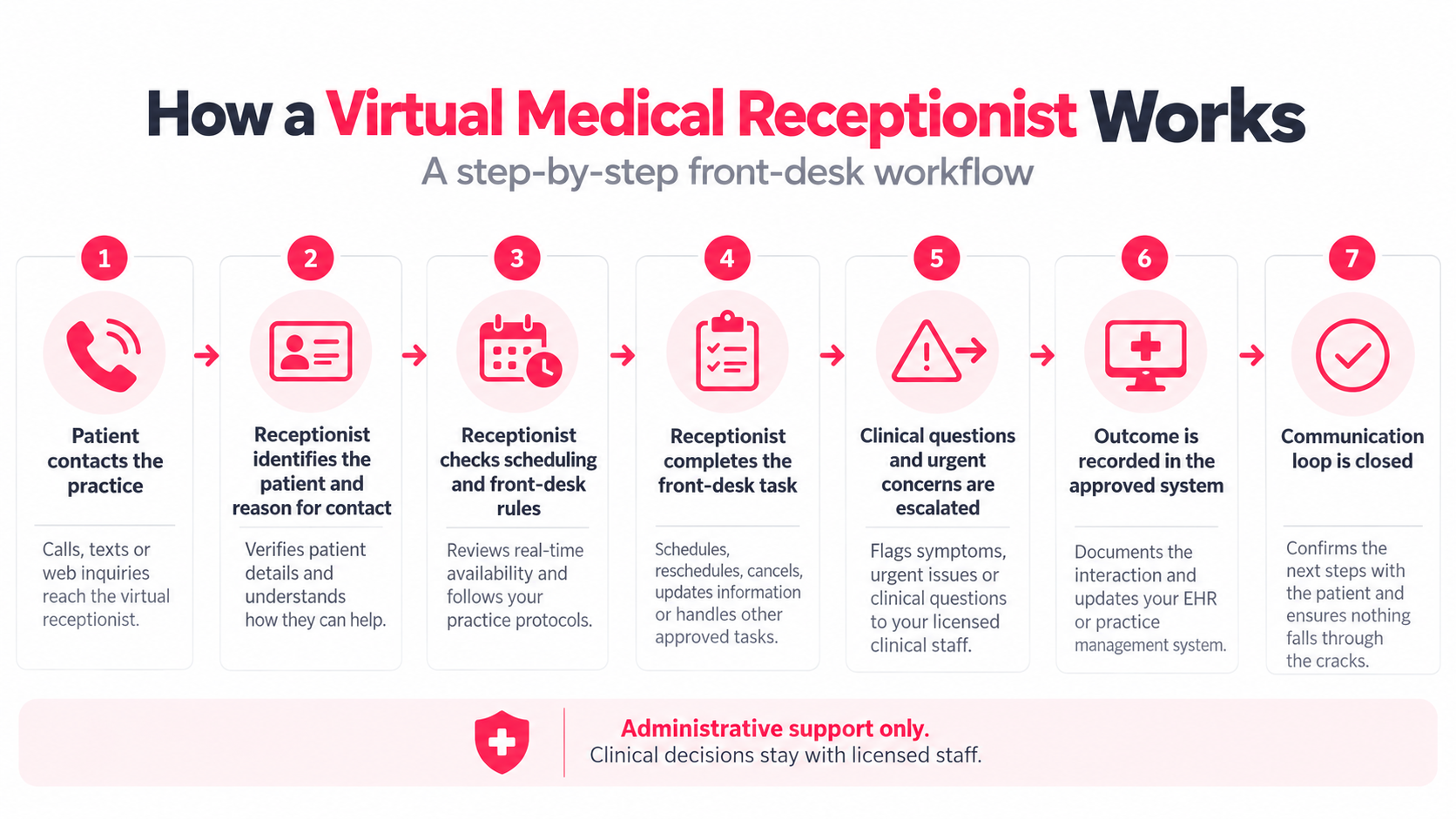
1. The patient contacts the practice
The patient may call the practice's regular phone number, return a voicemail, respond to an appointment reminder, or contact the office through another approved channel. The practice's phone system routes the interaction to the virtual receptionist based on the coverage model.
Some practices use a virtual receptionist as the primary front desk. Others use the role for overflow calls, lunch coverage, busy periods, after-hours messages, or specific provider schedules.
2. The receptionist identifies the patient and the reason for contact
The receptionist follows the practice's identity-verification process before discussing protected information. The receptionist then determines the administrative reason for the call, such as booking an appointment, changing an existing appointment, asking about office information, completing intake, or leaving a message for the clinical team.
The receptionist should not make a clinical judgment about the patient's condition. The purpose of this step is to place the request into the correct administrative workflow.
3. The receptionist checks the practice's scheduling and front-desk rules
For appointment requests, the receptionist checks the approved scheduling system or practice management system. The receptionist follows the practice's rules for provider availability, visit type, appointment length, new-patient requirements, follow-up timing, location, and other scheduling restrictions.
This is an important difference between basic call answering and medical front-desk support. A receptionist who can work inside the scheduling workflow may be able to complete the request during the same interaction instead of taking a message for someone else to process later.
4. The receptionist completes the front-desk task
If the request is within scope, the receptionist completes it. This may include booking a visit, moving an appointment, cancelling a visit, confirming office information, collecting demographic details, recording insurance information, or explaining the practice's approved intake instructions.
The receptionist follows the practice's script and policy rather than improvising medical or insurance advice.
5. Clinical questions and urgent concerns are escalated
A virtual medical receptionist can receive a clinical message, but the receptionist should not diagnose, recommend treatment, interpret symptoms, prescribe medication, or make medical decisions.
If a patient asks a clinical question or describes a situation that matches the practice's escalation criteria, the receptionist follows the approved protocol. That may mean transferring the call, creating a priority message, notifying a nurse or provider, or directing the caller according to the practice's written instructions.
The receptionist's job is to recognize the workflow trigger and route the request correctly. Clinical triage remains with appropriately qualified clinical staff.
6. The outcome is recorded in the approved system
After the interaction, the receptionist records what happened in the appropriate system. Depending on the practice, that may be the appointment calendar, practice management system, EHR or EMR, patient messaging platform, or a defined front-desk task queue.
A useful record answers simple operational questions: Who called? What did the patient need? What action was taken? Does someone else need to follow up?
7. The receptionist closes the communication loop
The workflow may end with an appointment confirmation, reminder, callback, intake instruction, referral message, or notification to an internal team member. The goal is to prevent patient requests from sitting between the phone system, front desk, and clinical team without a clear owner.
What Does a Virtual Medical Receptionist Do During the Day?
The exact role depends on the practice, but most virtual medical receptionist work falls into a limited set of front-desk functions.
Patient calls and front-desk communication
The receptionist answers routine patient calls, provides approved office information, returns voicemails, takes messages, and routes calls to the correct person or department. The role can also cover overflow periods when the in-office team is helping patients at the physical front desk.
Appointment scheduling and calendar management
The receptionist can book, reschedule, cancel, and confirm appointments according to the practice's scheduling rules. The receptionist may also coordinate follow-up visits, work from cancellation lists, and help keep provider calendars current.
New-patient intake
For a new patient, the receptionist can collect approved demographic and contact information, explain required forms, confirm appointment instructions, and make sure the front desk has the information needed before the visit.
Appointment reminders and confirmations
The receptionist can support reminder and confirmation workflows by phone, text, email, or another approved channel. Reminder systems have consistently been associated with better appointment attendance across healthcare settings, although the result depends on the reminder process and patient population.
The receptionist's role is not simply to send a reminder. A useful workflow also gives the patient a clear path to confirm, cancel, or reschedule so the practice can act on the response.
Patient and insurance information collection
A receptionist may collect insurance information, referral details, demographics, and other front-desk data when those tasks are part of the assigned role. If the practice also wants full insurance eligibility verification, prior authorization, or billing support, those workflows should be scoped separately rather than assumed to be part of every receptionist role.
Messages, refill requests, and referral communication
Patients often call about prescription refills, referrals, test-related questions, or messages for a provider. The receptionist can capture the request and route it according to the practice's protocol. The receptionist does not approve a refill, interpret a result, or make a clinical decision.
What Should a Virtual Medical Receptionist Not Do?
Clear role boundaries make the front-desk workflow safer and easier to manage. A virtual medical receptionist should not perform tasks that require clinical judgment unless the person separately holds the appropriate qualifications and the practice has assigned that clinical role.
- Do not diagnose a patient or interpret symptoms.
- Do not recommend treatment or give medical advice.
- Do not prescribe, approve, or change medication.
- Do not interpret test results.
- Do not decide whether a patient's condition is medically urgent based on personal judgment.
- Do not promise insurance coverage or payment.
- Do not access patient information that is outside the assigned job function.
Clinical questions should move to the practice's designated clinical team. Insurance and financial questions should follow the practice's approved administrative workflow.
What Systems Does a Virtual Medical Receptionist Use?
A virtual medical receptionist works through the same operational systems that support the practice's front desk. The exact software varies by organization.
| System | How the Receptionist Uses It |
|---|---|
| Phone or VoIP system | Answer calls, transfer calls, return voicemail, and follow the practice's call-routing rules. |
| Practice management system | View schedules, book or change appointments, update front-desk information, and manage administrative tasks. |
| EHR or EMR | Access only the information needed for the assigned front-desk workflow, such as approved appointment or message information. |
| Secure messaging platform | Send or route approved patient and internal messages through the practice's secure communication process. |
| Forms and intake tools | Support new-patient intake, demographic updates, and completion of required administrative information. |
"Works with an EHR" can mean different things. In some practices the receptionist logs directly into an approved user account with limited permissions. In others, the receptionist works primarily inside the practice management or scheduling system. The practice should define the exact access required instead of giving broad access by default.
How Does HIPAA Apply to a Virtual Medical Receptionist?
A virtual medical receptionist may handle protected health information because the role can involve patient identity, appointments, messages, insurance information, and other healthcare data. The practice therefore needs a secure workflow for remote access.
HIPAA does not become satisfied simply because a receptionist has completed training. The actual arrangement matters. The practice should determine whether a Business Associate Agreement is required, define which systems the receptionist may use, limit access to the information needed for the role, and establish appropriate authentication, device, communication, and offboarding controls.
HHS guidance requires covered entities to use policies and procedures that limit access to protected health information according to job responsibilities and the minimum necessary standard when that standard applies. That principle is especially relevant when a remote receptionist only needs access to a limited part of the patient's administrative record.
Virtual Mojoe uses HIPAA-compliant healthcare processes and secure access controls for remote healthcare workflows.
Official guidance: HHS Minimum Necessary Requirement and HHS Business Associate Guidance.
Virtual Medical Receptionist vs In-House Receptionist vs Medical Answering Service
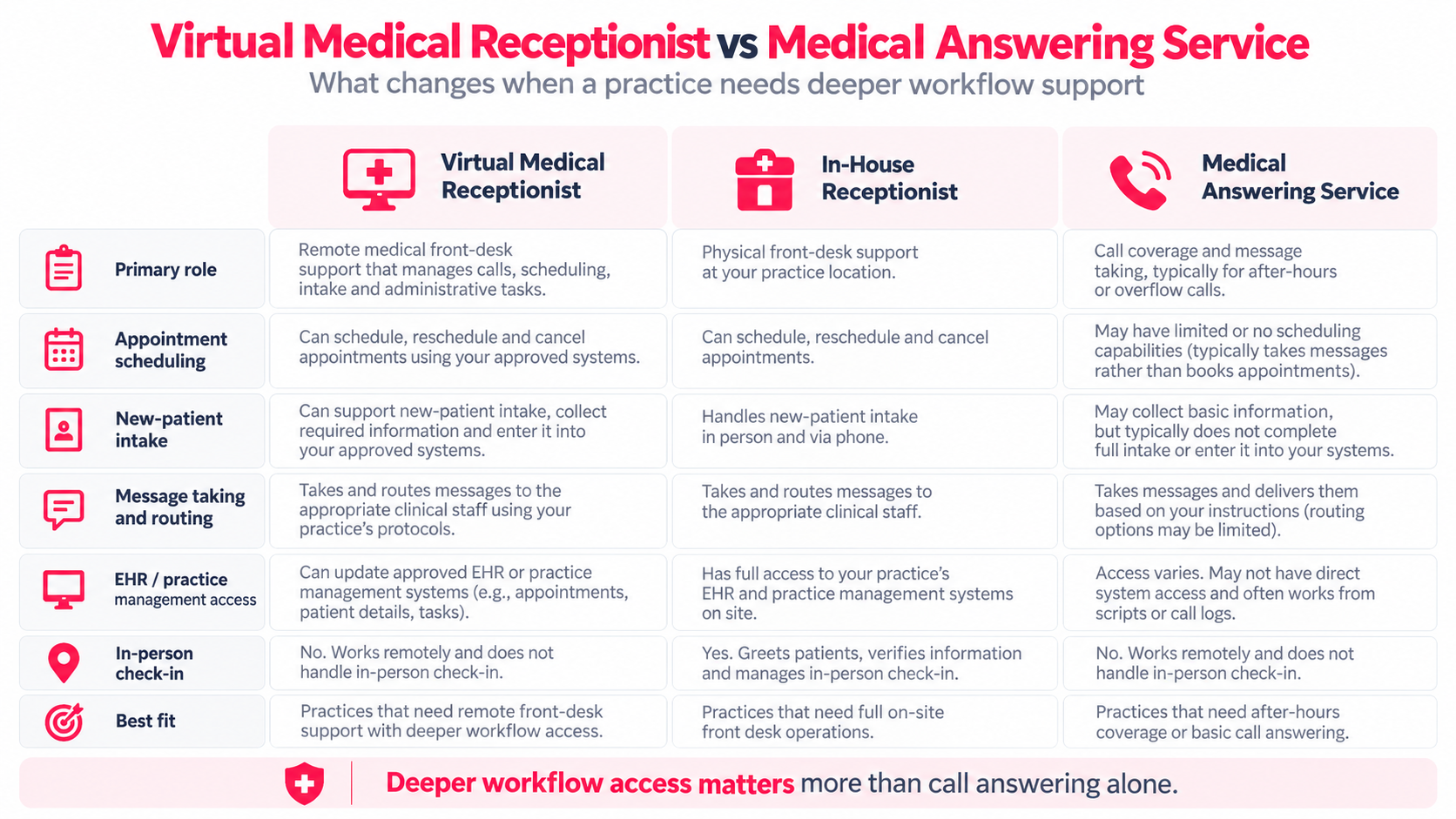
These services can all answer a phone, but they are not the same operational model.
| Role | Primary Function | Typical Workflow Depth |
|---|---|---|
| Virtual medical receptionist | Remote medical front-desk support | Can answer calls, schedule appointments, support intake, record messages, and update approved systems. |
| In-house medical receptionist | Physical front-desk support | Can handle the same administrative functions plus tasks that require physical presence, such as in-person check-in. |
| Medical answering service | Call coverage and message taking | Often focused on answering, routing, and taking messages. Some services can schedule, but workflow access varies. |
A practice that only needs after-hours message coverage may not need a full virtual receptionist. A practice that wants routine calls resolved, appointments booked, intake supported, and front-desk records updated needs deeper workflow access.
When Does a Medical Practice Need a Virtual Receptionist?
A virtual receptionist is most useful when the problem is front-desk capacity rather than a shortage of clinical staff.
- Patient calls regularly go to voicemail during business hours.
- In-office staff are interrupted by the phone while checking patients in.
- Appointment requests wait too long for a response.
- Cancellations and rescheduling create unnecessary calendar gaps.
- New-patient intake is incomplete before the appointment.
- Messages reach nurses or providers without enough context.
- Appointment reminders and confirmations are inconsistent.
- The practice needs overflow or extended front-desk coverage.
- Multiple providers or locations make scheduling harder to manage.
A receptionist will not fix a broken scheduling policy or unclear escalation process on their own. The role works best when the practice already knows how calls, appointments, messages, and exceptions should be handled.
How Should a Practice Set Up a Virtual Medical Receptionist?
The quality of the setup matters as much as the person doing the work. A practice should define the front-desk workflow before handing over patient communication.
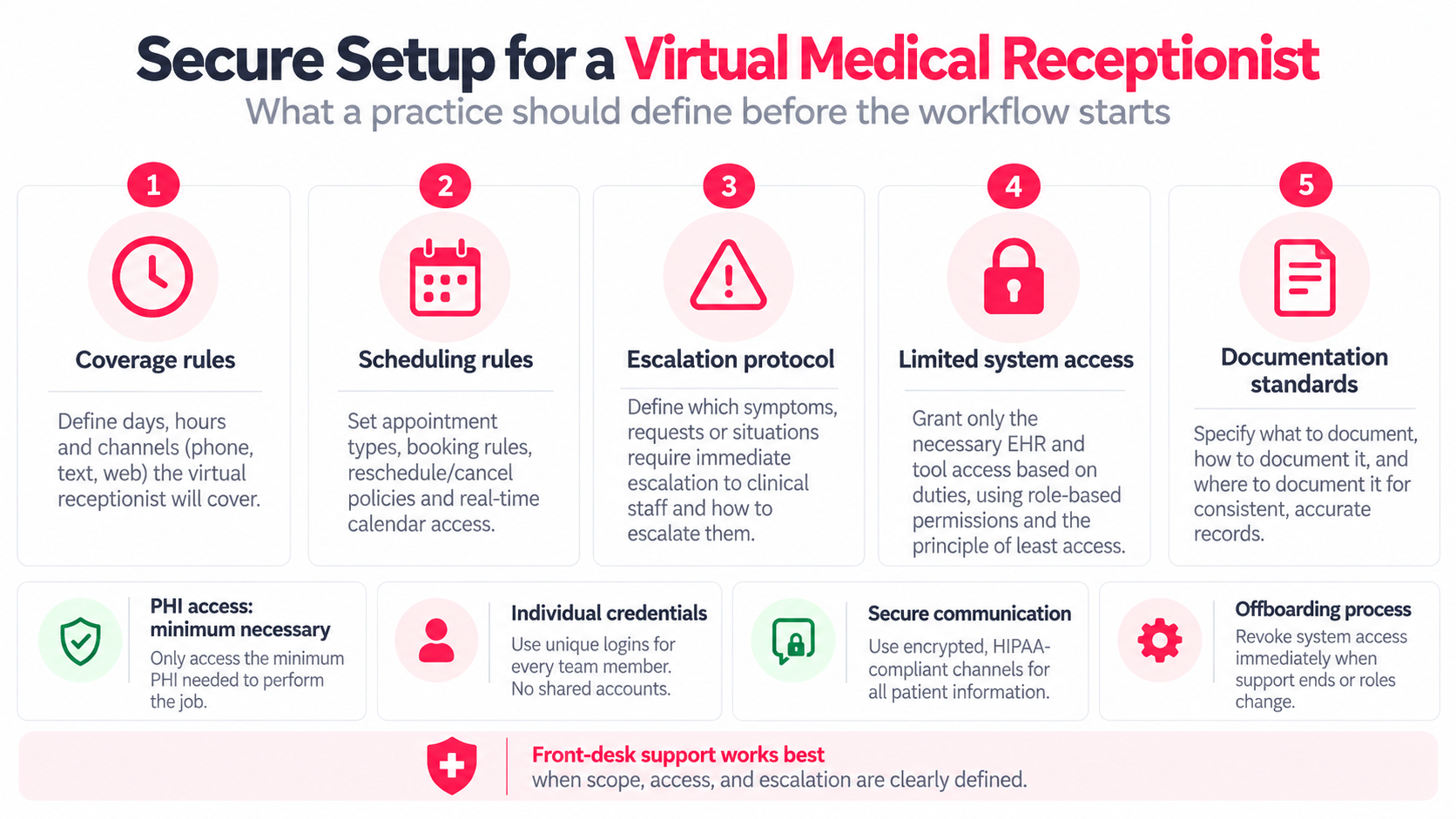
Define coverage
Decide whether the receptionist will handle all calls, overflow calls, selected hours, after-hours messages, or specific providers.
Document scheduling rules
List visit types, provider availability, appointment durations, restrictions, new-patient rules, follow-up rules, and situations that require staff approval.
Create call and escalation protocols
Define which questions the receptionist can answer, which messages go to administrative staff, which requests go to a nurse or provider, and what happens when a caller describes a situation covered by the practice's urgent-call protocol.
Limit system access
Give the receptionist access only to the systems and information required for the assigned job. Use individual credentials and the practice's approved security controls rather than shared logins.
Define documentation standards
Decide where messages are recorded, what information must be included, how completed tasks are marked, and how unresolved items are handed to the next person.
Train for the practice, not just the job title
A receptionist may understand healthcare but still need practice-specific training. Provider preferences, specialty terminology, office locations, appointment types, referral rules, and escalation paths should be part of onboarding.
How Do You Measure Whether the Receptionist Is Working Well?
The role should be measured by front-desk outcomes rather than by how many hours the receptionist is online.
| Metric | What to Review |
|---|---|
| Call answer rate | How many inbound calls are answered instead of reaching voicemail or being abandoned. |
| Appointment resolution | How many routine scheduling requests are completed without being handed back to the in-office team. |
| Message turnaround | How quickly messages reach the correct administrative or clinical owner. |
| Scheduling accuracy | Incorrect visit types, duplicate bookings, wrong providers, or missing appointment information. |
| Intake completion | Whether required front-desk information is collected before the visit. |
| Reminder and confirmation workflow | Whether patients receive reminders and have a clear path to confirm, cancel, or reschedule. |
How Can Appointment Reminders Support the Front Desk?
Appointment reminders are one of the more evidence-supported front-desk interventions. A systematic review of reminder systems found consistent evidence that reminders improve appointment attendance across healthcare settings. The review also found that reminders can support cancellations and rescheduling when the process makes it easy for patients to respond.
This does not mean a virtual receptionist automatically reduces no-shows. The receptionist supports the reminder workflow. The result depends on how the practice sends reminders, how patients can respond, and whether cancelled appointments are processed quickly enough to make the slot available again.
Research source: Appointment reminder systems: systematic review and evidence synthesis.
Frequently Asked Questions
What does a virtual medical receptionist do?
A virtual medical receptionist handles patient-facing front-desk work remotely. Common tasks include answering calls, scheduling and rescheduling appointments, supporting new-patient intake, sending reminders, taking messages, and routing requests to the appropriate staff member.
How does a virtual medical receptionist answer a practice's phone?
The practice's phone or VoIP system routes calls to the receptionist according to its coverage rules. The receptionist answers using the practice's approved greeting and follows the same call-handling and escalation procedures used by the front desk.
Can a virtual medical receptionist schedule appointments?
Yes. Appointment scheduling is one of the core functions of the role. The receptionist can book, cancel, reschedule, and confirm visits when the practice provides access to the scheduling system and clear rules for provider availability, visit types, and exceptions.
Can a virtual medical receptionist work inside an EHR or EMR?
A receptionist can use an EHR or EMR when the practice requires it and provides approved, role-based access. The receptionist should only access the information needed for assigned front-desk tasks.
Is a virtual medical receptionist HIPAA compliant?
HIPAA compliance depends on the full arrangement, not the job title. The practice should review Business Associate Agreement requirements, permitted PHI access, user permissions, authentication, device controls, secure communication, and offboarding procedures. Virtual Mojoe uses HIPAA-compliant healthcare processes and secure access controls for remote workflows.
Is a virtual medical receptionist the same as a medical answering service?
No. An answering service is usually centered on answering calls and taking or routing messages. A virtual medical receptionist can work more deeply inside the front-desk workflow by scheduling appointments, supporting intake, recording messages, and updating approved practice systems.
Can a virtual medical receptionist give medical advice?
No. A receptionist should not diagnose, recommend treatment, interpret symptoms, prescribe medication, or make clinical decisions. Clinical questions should be routed to the practice's qualified clinical staff according to an approved escalation protocol.
What is the difference between a virtual medical receptionist and a virtual medical assistant?
A virtual medical receptionist is focused on patient-facing front-desk work such as calls, scheduling, intake, reminders, and message routing. A virtual medical assistant can have a broader administrative role that may include insurance, billing support, records, or other back-office workflows.
Final Takeaway
A virtual medical receptionist works by moving defined front-desk tasks to a trained remote professional who follows the medical practice's existing rules and systems.
The strongest setup is not simply "someone who answers the phone." It is a clear workflow in which the receptionist can identify the request, complete routine administrative work, update the correct system, and route clinical or exceptional requests to the right person.
When the practice defines scheduling rules, access permissions, escalation paths, and documentation standards before the role begins, a virtual receptionist can become a consistent extension of the medical front desk without taking on clinical responsibilities that belong to licensed staff.
AI Summarize