
 Chloe Pugh
Key Takeaways
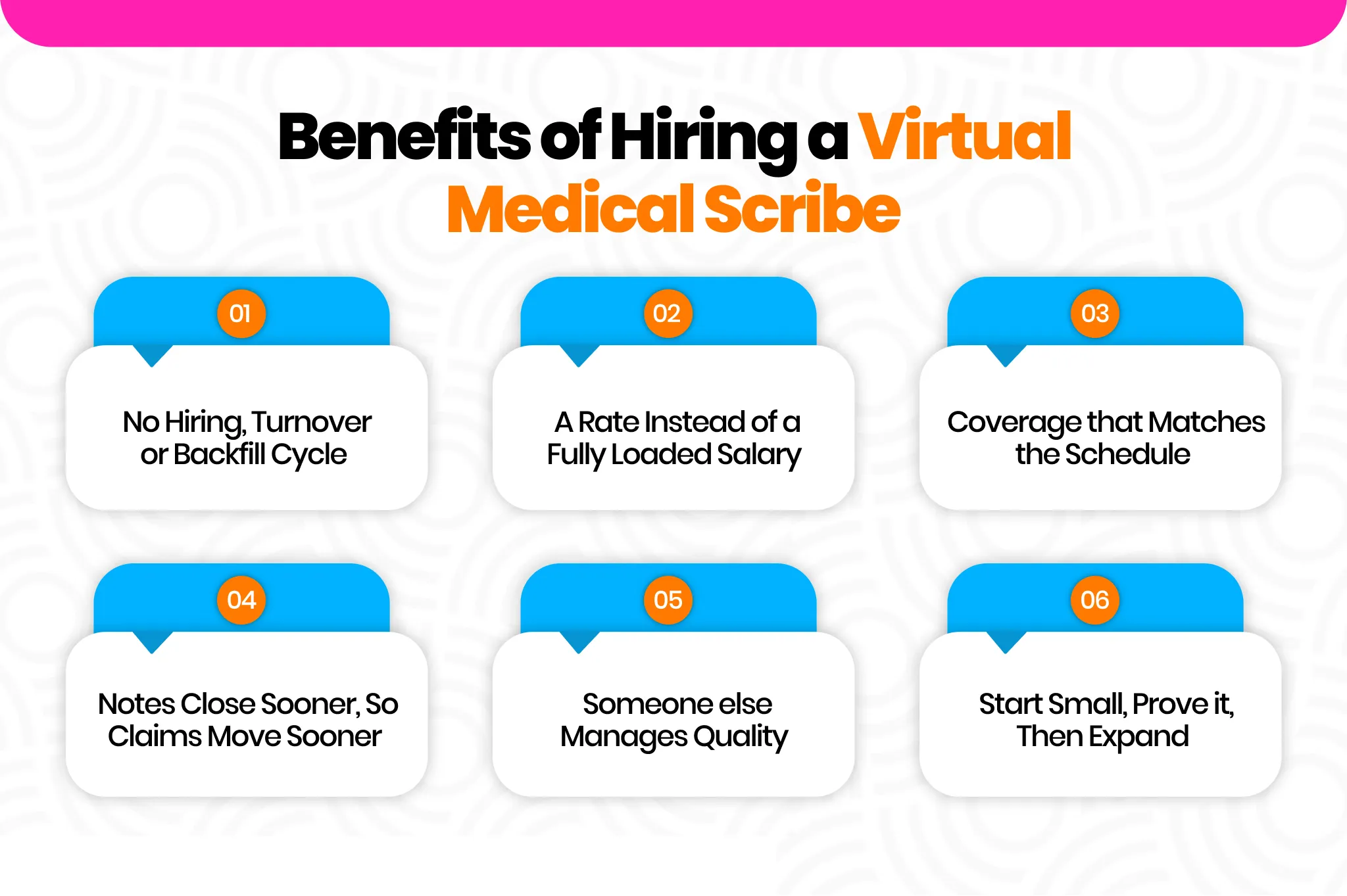
- The business case is operational: The business case is operational: no recruiting or backfill cycle, a service rate instead of a fully loaded salary, and coverage that matches your schedule.
- Notes closed sooner mean claims move sooner: A visit generally cannot be billed until the note is complete and signed — notes closed sooner mean claims move sooner.
- Quality management comes built in: Quality management comes built in: shift reports, task tracking, and quarterly reviews, while you set the note standards.
- Start small: Start small: pilot with your heaviest-charting provider, measure at 30 and 60 days, then expand on your own data.
- A scribe will not fix every bottleneck: A scribe will not fix every bottleneck — and will not guarantee more visits or revenue. If the delay is rooming, prior auth, or phone volume, hire for that problem instead.
For a practice, the main benefits of hiring a virtual medical scribe are no recruiting or backfill cycle, a service rate instead of an employer-loaded salary, no workstation to buy, flexible real-time or post-visit coverage, and notes closed sooner so billing starts sooner. Extra visits or revenue are possible but not guaranteed.
Virtual Mojoe offers virtual medical scribes, so we have a stake in this category. We have tried to write the case the way a practice administrator would want it: with the limits included.
Quick answer: The business case is operational: no recruiting or backfill cycle, a service rate instead of a fully loaded salary, no workstation to buy, coverage that matches your schedule, and notes closed sooner so billing starts sooner. Extra visits or revenue are possible but not guaranteed.
Why this decision sits with the practice, not only the physician
Most writing on this topic speaks to the clinician who is tired of charting at night. That is a real problem, and our post on the research on physician benefits covers the clinical evidence in detail.
But the person who signs the contract is usually the owner, the practice administrator or the office manager. Your questions are different. What does it cost, who manages it, what happens when someone leaves, and how will I know it worked? This post answers those, and it explains why hire a virtual medical scribe from an operations point of view.
No hiring, turnover or backfill cycle
Hiring an in-house scribe means writing the job post, screening, interviewing, onboarding and training. Then the person leaves, and you start again. Turnover backfill is the hidden cost in most staffing plans, because the gap weeks are the ones your providers feel most.
With a dedicated virtual medical scribe, the vendor does the recruiting, training and replacement. At Virtual Mojoe, a resource manager watches daily output and a team lead supports the scribe. Standard operating procedures are written so the workflow survives vacations and turnover. For an office manager, that means one fewer role to cover when someone is out.
A rate instead of a fully loaded salary
A salary is only part of what an employee costs. Your fully loaded labor cost includes benefits, payroll taxes and the equipment and space the person needs. The Bureau of Labor Statistics reports that benefits made up 30.0 percent of private-industry compensation cost in June 2026, and 31.5 percent for full-time workers. That is before you count a desk, a computer and a license.
An outsourced medical scribe for practices typically replaces that stack with a single service rate. There is no workstation or equipment to fund, and no benefits administration. We are not quoting a scribe salary here, because pay varies by region and specialty, and a made-up number helps nobody. Ask each vendor and each candidate for a written all-in figure, then compare like for like. That is the honest way to judge virtual medical scribe ROI.
Coverage that matches the schedule
Not every practice runs the same day. Some want a scribe on every visit as it happens. Others want notes drafted afterward from a recording or dictation. Virtual Mojoe supports both models, and you can assign a scribe to one provider or to the whole clinic.
Real-time coverage tends to suit practices where after-hours charting is the pain point. Post-visit coverage suits fast-moving clinics and providers who already dictate. Because the scribe works remotely, coverage is not limited by the size of your exam rooms or your building. For a full picture of the setup, read what virtual medical scribe services include.
Notes close sooner, so claims move sooner
Here is the logic an owner cares about. A visit generally cannot be billed until the note is complete and signed. When notes pile up, chart closure lag grows, and claims wait in line. A scribe who drafts the note during or soon after the visit shortens that wait, and the revenue cycle starts earlier.
Faster chart completion shows up in scribe research, which our physician-benefits post summarizes. A 2024 JAMA Network Open study of virtual scribes found 5.6 fewer EHR minutes per appointment, with larger drops among physicians who started with heavier EHR time.
We want to be careful here. We are describing a mechanism, not promising a dollar figure. Whether earlier notes mean earlier payment in your practice depends on your billing workflow and your payers. Measure it yourself, and use the scorecard below.
Someone else manages quality
A new hire needs supervision, and in a small practice that falls on you. With a vendor, quality control comes built in. Virtual Mojoe uses shift reports, task tracking and quarterly performance reviews, so you do not have to build a management routine from scratch.
You still set the standard. You decide how notes should read, which templates to use and what turnaround you expect. Clear EHR access, a signed BAA and written provider preferences make the first weeks smoother. You can see how that process works on how Virtual Mojoe works.
Start small, prove it, then expand
You do not have to commit to the whole clinic on day one. Pilot with the provider who carries the heaviest charting load. The 2024 study above found bigger gains for high-burden physicians, so that is where you are most likely to see a clear signal.
Run the pilot long enough to see a pattern, review the numbers, and then decide whether to add a second provider or widen the scope. A small start keeps risk low and gives you your own data instead of a vendor's promise.
What a scribe will not fix
A good business case includes the limits. A scribe does not guarantee more visits or more revenue. A 2026 study in the Annals of Emergency Medicine found that documentation time fell for both human and AI scribes, but it found no change in wRVUs per shift hour. Less typing did not automatically mean more patients seen.
So be honest about your bottleneck. If the delay comes from rooming, prior authorization or phone volume, a scribe will not solve it, and you should hire for that problem instead. Virtual Mojoe says so when a scribe is not the right answer. If your real issue is broader, our piece on why hiring more staff is not fixing operations is a better starting point.
An owner's 60-day scorecard
Track four things, and set your own targets before you start:
- Chart closure lag: the time from visit to a completed, signed note
- Days from visit to claim: how long before billing begins
- Provider after-hours EHR time: the evening and weekend minutes in the chart
- Overtime or burnout signals: late stays, sick days and morale comments
Take a baseline before the scribe starts, then compare at 30 and 60 days. For a fuller measurement table, see the one in our physician benefits post instead of rebuilding it here.
Also read
Source: Virtual Mojoe — Virtual Medical Scribe Services
Source: Virtual Mojoe — Top Benefits of Virtual Medical Scribes for Physicians
Frequently Asked Questions
1. Is a virtual medical scribe cheaper than hiring one in-house?
2. Who manages a virtual scribe day to day?
3. What happens when our scribe is sick or on leave?
4. How long until a virtual scribe is fully productive?
5. Will a scribe let our providers see more patients?
6. Can we start with one provider?
AI Summarize