 Chloe Pugh
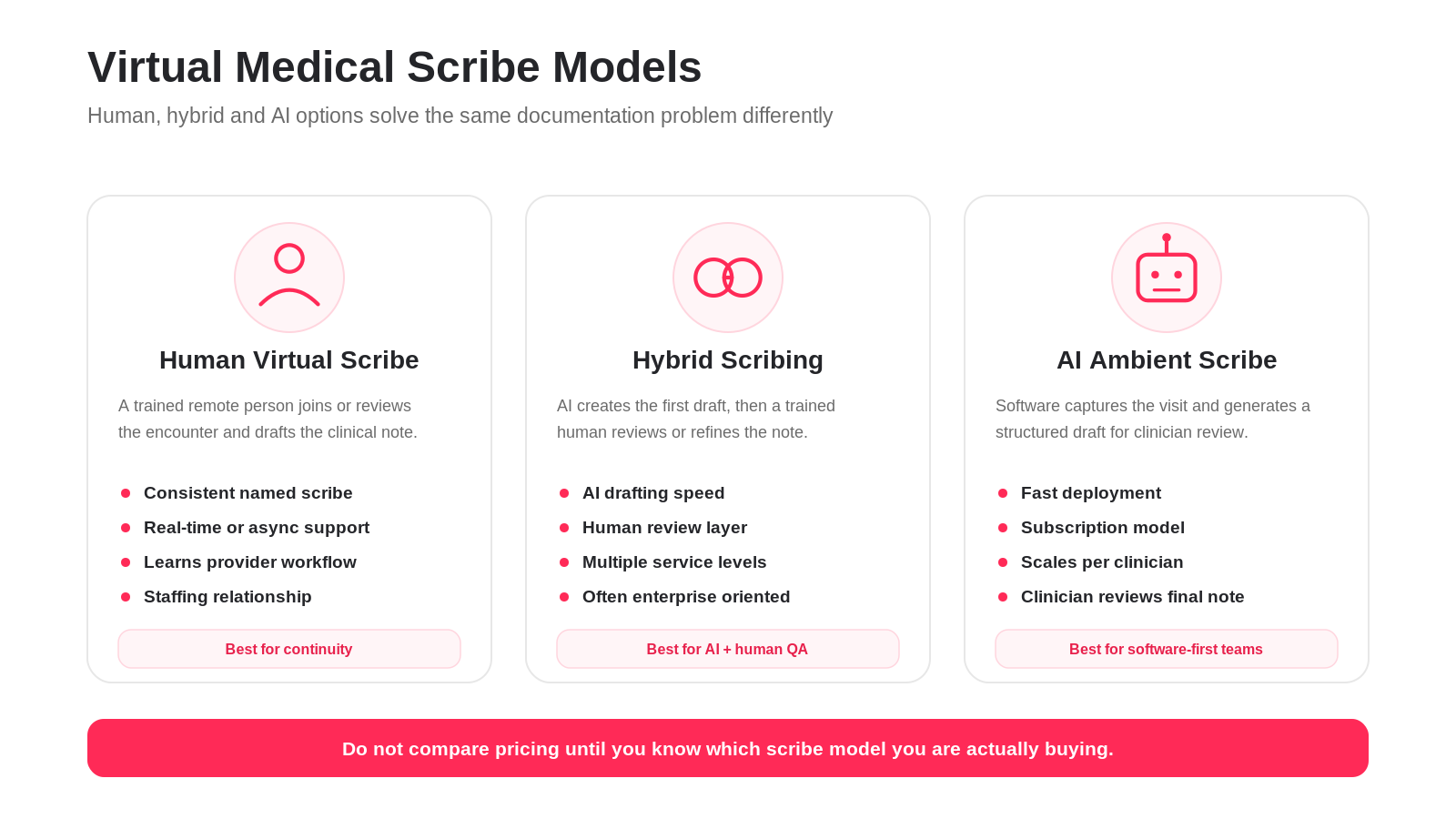
The virtual medical scribe market now includes three different products under one search term: dedicated human remote scribes, hybrid services that combine AI with human review, and ambient AI platforms that generate draft clinical notes.
A practice comparing vendors in 2026 therefore has to look beyond a provider list and ask a harder question: which documentation model actually fits our clinicians, EHR, specialty, security requirements, and review workflow?
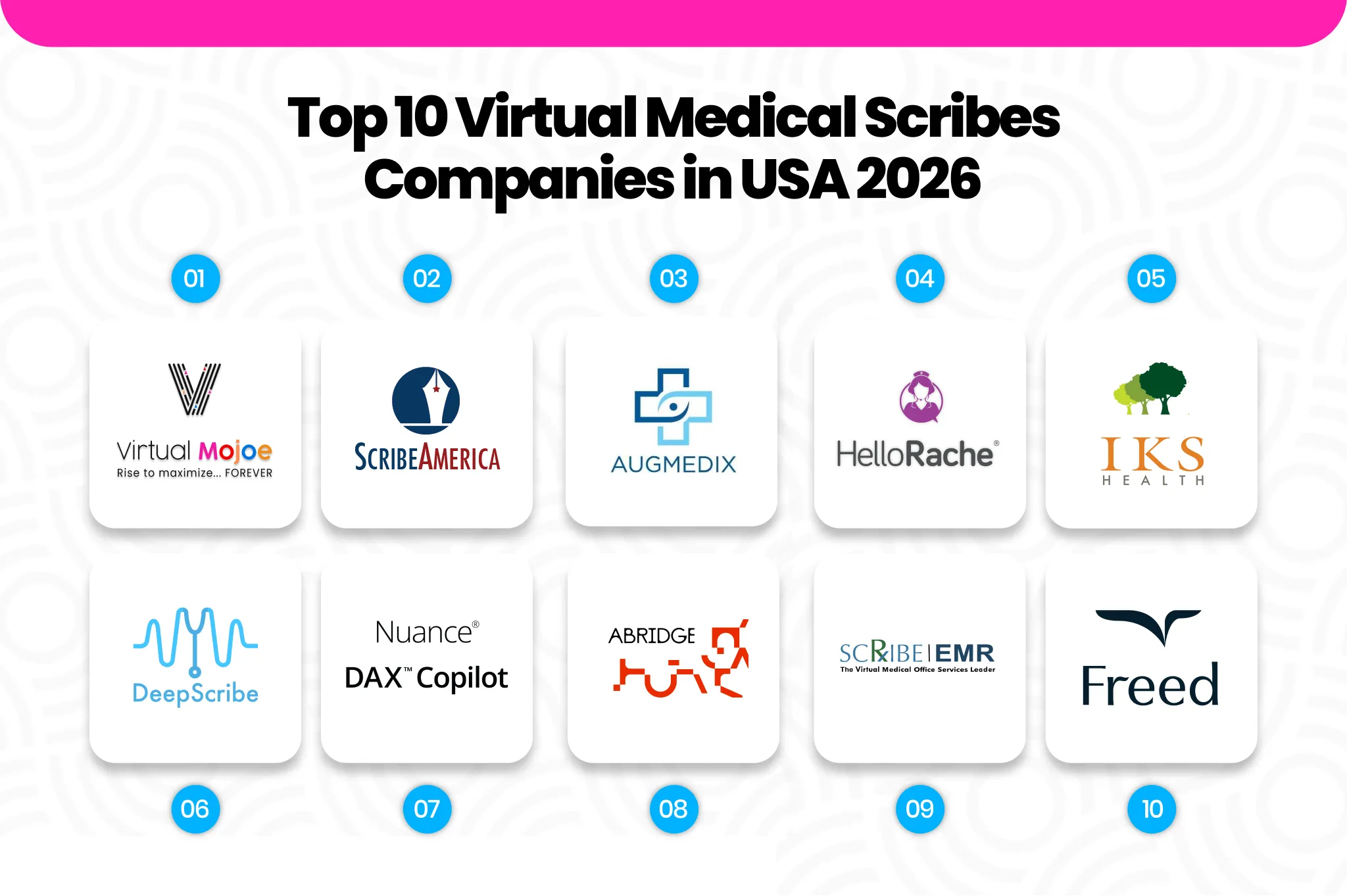
Quick answer: The 10 companies and platforms in this guide are Virtual Mojoe, ScribeAmerica, Augmedix by Commure, Hello Rache, IKS Health, DeepScribe, Microsoft Dragon DAX Copilot, Abridge, ScribeEMR, and Freed. The same providers can look very different in practice. Virtual Mojoe, ScribeAmerica, and Hello Rache are human-first options. ScribeEMR, IKS Health, and Augmedix provide multiple service levels that combine human and AI documentation. DeepScribe, Abridge, Dragon DAX Copilot, and Freed are software-first ambient AI options.
Top Virtual Medical Scribe Companies at a Glance
The table below is the fastest way to narrow the market. Pricing refers only to publicly available information as of September 2026. A custom quote does not mean two vendors have similar pricing because staffing, enterprise software, implementation, and support are sold very differently.
| Provider | Primary Model | Best-Fit Buyer | Public Pricing |
|---|---|---|---|
| Virtual Mojoe | Dedicated human remote scribe | Practices wanting a consistent human team member | Custom quote |
| ScribeAmerica | Domestic human virtual scribes | Health systems and groups needing real-time human coverage at scale | Custom quote |
| Augmedix by Commure | AI, AI + specialist, and synchronous service tiers | Health systems comparing several levels of automation and service | Custom / enterprise |
| Hello Rache | Dedicated human virtual scribe | Practices wanting transparent hourly human support | $9.50/hour |
| IKS Health | AI, hybrid, transcription, and live human options | Larger groups wanting several documentation service levels | Custom / enterprise |
| DeepScribe | Specialty-focused ambient AI | Specialty practices needing deep AI customization and EHR integration | Custom quote |
| Dragon DAX Copilot | Enterprise ambient AI | Organizations already evaluating Microsoft or Dragon clinical workflows | Contact sales |
| Abridge | Enterprise ambient AI | Large health systems, particularly those with deeply integrated Epic workflows | Custom / enterprise |
| ScribeEMR | Human, hybrid, and AI | Practices that want to choose among all three scribe models | Custom quote |
| Freed | Self-serve ambient AI | Individual clinicians and smaller groups | From $39/month |
Pricing and product packaging can change. Verify current rates, EHR support, BAA terms, implementation requirements, and support levels directly with the vendor.
Detailed Comparison of the 10 Virtual Medical Scribe Companies
1. Virtual Mojoe
Dedicated Human ScribeVirtual Mojoe is the most staffing-oriented option in this comparison. The proposition is not an ambient AI license. It is a dedicated human remote scribe integrated into a medical practice's documentation workflow. Virtual Mojoe operates with HIPAA-compliant healthcare processes and secure access controls for approved remote workflows.
That model is most relevant when a physician wants continuity with a named team member who can learn documentation preferences, scheduling patterns, specialty terminology, and the practice's approved EHR process over time. It also means the buying process should look more like hiring and workflow design than purchasing software.
Implementation details to define
- The candidate's direct experience with your exact EHR
- Your specialty and preferred note structure
- Whether the workflow is live, post-visit, or a combination
- Coverage hours, backup expectations, and replacement process
- PHI scope, user permissions, device, authentication, communication, and agreement requirements for the engagement
Best fit: Practices that want a human scribe relationship and prefer staffing continuity over a software-only approach.
2. ScribeAmerica
Domestic Real-Time Human ScribingScribeAmerica is one of the clearest examples of a traditional scribe operation moved into a remote environment. Its virtual program uses domestic scribes connected to the clinician in real time through secure video or audio. The scribe documents directly into the EHR while the visit is happening.
The company publishes a detailed training model of approximately 120 hours per scribe, including medical terminology, HIPAA and PHI compliance, billing documentation, supervised clinical training, chart review, periodic reassessment, and provider-to-scribe satisfaction reporting.
What stands out
- Real-time human charting rather than AI draft generation
- Domestic virtual scribe positioning
- Published training and quality-assurance process
- Audio and video workflow options
What to verify
- Exact EHR compatibility and credentialing requirements
- Coverage for your specialty and provider schedule
- Pricing and minimum volume
- Backup coverage and implementation timeline
Best fit: Health systems, larger groups, and practices that want an established real-time human scribe model.
Source: ScribeAmerica Virtual Scribes
3. Augmedix by Commure
AI to Full-Service ContinuumAugmedix is useful in this comparison because it does not force one documentation model on every clinician. Commure currently describes three service levels: Augmedix Go, Augmedix Assist, and Augmedix Live.
Go is the AI-focused option. Assist adds a specialist support layer. Live is the full-service synchronous documentation option. That continuum lets a health system decide how much human involvement it wants around ambient documentation instead of treating human and AI scribing as separate procurement categories.
What stands out
- Several levels of human involvement within one vendor family
- Enterprise health-system orientation
- Ambient AI plus structured-data and point-of-care workflow positioning
What to verify
- The exact difference in workflow and turnaround between Go, Assist, and Live
- Current EHR integration for your health system
- Current BAA and security documentation
- Implementation support and clinician-change management
Best fit: Health systems that want to choose among AI-only, AI-plus-service, and synchronous documentation models.
4. Hello Rache
Transparent Hourly Human ScribingHello Rache offers a dedicated human virtual medical scribe who documents encounters in real time inside the practice's existing EMR or EHR. The same scribe can work with the practice consistently, which gives the service a staffing relationship rather than a rotating software workflow.
Hello Rache is also one of the easiest providers to price-check because it publicly lists $9.50 per hour, no setup fees, no long-term contract, and weekly billing. Its site states that connections are encrypted and that scribes receive HIPAA training before assignment.
What stands out
- Transparent hourly pricing
- Same assistant every day model
- Direct charting inside the client's EHR or EMR
- Can be relevant when the practice also needs adjacent healthcare VA support
What to verify
- Exact experience with your EHR and specialty
- Backup coverage when the dedicated scribe is unavailable
- Scope boundaries if the role also includes administrative VA work
- BAA terms and your practice's required access controls
Best fit: Practices wanting a human scribe with simple, published hourly pricing.
5. IKS Health
Five Documentation Service LevelsIKS Health has one of the broadest documentation-model portfolios in this comparison. Its Scribble suite currently includes Scribble Now, Scribble Swift, Scribble Pro, Scribble Transcribe, and Scribble Live.
The distinction is unusually clear. Scribble Now is AI-only with notes generated in minutes. Scribble Swift adds human scribe validation and EHR posting with roughly one-hour turnaround. Scribble Pro adds clinician-scribe review and is positioned for more complex documentation, with a stated four-hour turnaround. Scribble Live uses dedicated virtual medical scribes for live clinical workflow support. IKS also lists Epic Connection Hub integration.
What stands out
- Clear progression from AI-only to human-supported and live scribing
- Epic Connection Hub availability
- Published HIPAA and SOC 2 Type 2 claims for the ambient suite
- 2026 Best in KLAS recognition for Virtual Scribing Services, with IKS reporting a 91.9 score
What to verify
- Which Scribble tier matches your specialty and required turnaround
- Non-Epic integration requirements
- Pricing difference between Now, Swift, Pro, and Live
- Who reviews and posts the final note in your selected tier
Best fit: Multi-provider organizations and health systems that want several documentation models from one vendor.
Source: IKS Health Scribble Suite
6. DeepScribe
Specialty-Focused Ambient AIDeepScribe is an ambient AI platform with a particularly strong specialty-care position. Its public materials emphasize models tuned for oncology, cardiology, gastroenterology, urology, orthopedics, neurology, and other complex specialties rather than a single generic note generator.
The platform also goes beyond the encounter itself. DeepScribe publishes AI pre-charting, coding support for ICD-10, E/M and HCC workflows, a customization studio, and bi-directional EHR integration. Its Epic integration can pull relevant patient context forward and sync documentation and coding suggestions back to the EHR.
Publicly named EHR and workflow signals
- Epic integration, including Haiku and Canto
- athenahealth, eClinicalWorks, and DrChrono referenced in DeepScribe materials
- Specialty EHR integrations such as OncoEMR and iKnowMed
- Pre-charting, context pull-forward, note generation, and coding support
Security signals
- HIPAA-compliance claim
- AES-256 encryption
- Multi-factor authentication
- Role-based / limited access controls
- Business Associate Agreement language in its published terms
Best fit: Specialty practices and health systems that want ambient AI with deep customization, contextual documentation, and stronger EHR integration.
Sources: DeepScribe Specialties · DeepScribe Epic Integration
7. Microsoft Dragon DAX Copilot
Enterprise Ambient AIDragon DAX Copilot is Microsoft's and Nuance's enterprise ambient documentation product. It captures multi-party clinical conversations and generates draft documentation for clinician review using Microsoft Cloud for Healthcare infrastructure.
This is not a remote-human-scribe service. The value proposition is enterprise clinical AI, so the implementation questions are EHR embedding, governance, clinician adoption, template behavior, transcript workflow, security, and integration with the organization's existing Microsoft and Dragon environment.
What stands out
- Enterprise-scale Microsoft healthcare ecosystem
- HITRUST-CSF certification stated on the Microsoft Marketplace listing
- Ambient multi-party conversation capture
- Clinician editing through voice, keyboard, prompts, and EHR-connected workflows
What to verify
- Your exact EHR integration path and implementation requirements
- How notes and transcripts move into the EHR
- Recording and transcript retention policies under your contract
- Deployment timeline, support, and governance requirements
Best fit: Large healthcare organizations already investing in Microsoft or Dragon clinical infrastructure.
8. Abridge
Epic-Integrated Enterprise AIAbridge is an enterprise generative AI platform for clinical conversations. It converts encounters into clinically useful and billable documentation and is built for large-scale deployment across outpatient, emergency, and inpatient care.
Abridge's current materials emphasize deep Epic integration. Its inpatient and emergency workflows use Epic environments such as Haiku, Hyperspace, and ASAP. The company also states support for 28+ languages and 50+ specialties across care settings.
EHR and security evidence
- Deeply integrated Epic workflows publicly documented
- HIPAA-compliance claim
- U.S.-based data centers
- 256-bit encryption at rest and in transit
- SOC 2 Type 2 report available through its Trust Center
- Public Business Associate Agreement
What to verify
- Integration outside your specific Epic environment, if applicable
- Implementation scope for inpatient, outpatient, and emergency departments
- How clinician preferences, templates, and downstream actions are configured
- Enterprise pricing and support model
Best fit: Health systems that want deeply embedded ambient AI, particularly in Epic-centric environments.
Sources: Abridge Product · Abridge Trust Center
9. ScribeEMR
Human + Hybrid + AIScribeEMR is one of the strongest examples of a vendor that lets a buyer compare all three models without changing companies. Its lineup includes live virtual medical scribing, ScribeRyte AI Plus with human review, and ScribeRyte AI Instant for ambient AI.
ScribeEMR states that it supports 40+ clinical specialties across 45+ EMR platforms, including Epic, athenahealth, eClinicalWorks, Oracle Health/Cerner, and NextGen. It also states that most practices are fully operational within 5 to 10 business days.
What stands out
- Dedicated human scribe for complex specialties
- Hybrid AI draft plus trained human review
- AI-only option for high-volume lower-complexity workflows
- HIPAA and SOC 2 Type II positioning
- Backup coverage described for human scribe assignments
- Best in KLAS Virtual Scribing recognition stated for 2024, 2025, and 2026
Best fit: Practices that want to evaluate human, hybrid, and AI models without moving between unrelated vendors.
10. Freed
Self-Serve AI for Clinicians and GroupsFreed sits at the opposite end of the buying journey from a staffed human scribe or enterprise implementation. It is a self-serve AI medical scribe with individual subscription tiers plus a group plan.
Freed currently publishes Starter at $39 per month, Core at $79, and Premier at $119 monthly, with the annual Premier equivalent listed at $104 per month. The Premier tier adds EHR push, prior-visit summaries, patient context, instructions, letters, and coding features. Group plans add centralized administration, SSO, onboarding, and a dedicated account manager.
EHR and security evidence
- Copy-and-paste workflow works alongside EHRs generally
- Chrome extension can transfer notes to browser-based EHRs
- EHR Push is available for supported browser-based EHR workflows
- HIPAA, SOC 2 Type 1 and Type 2, and HITECH claims
- BAA included in platform terms according to Freed's help center
- Freed states it does not store patient recordings
Best fit: Individual clinicians and smaller groups that want to start with a lower-cost AI scribe without a staffing relationship or enterprise rollout.
Sources: Freed Pricing · Freed EHR Push
EHR Integration Comparison: "Compatible" Is Not Specific Enough
EHR support is one of the most misleading comparison points in the scribe market. A vendor can honestly say it "works with Epic" while delivering a completely different workflow from another vendor that is embedded directly into Epic. The integration depth matters because it determines how much copying, credentialing, template setup, context retrieval, and manual review remain.
| Provider | Public EHR Evidence | Integration / Entry Model | Buyer Should Confirm |
|---|---|---|---|
| Virtual Mojoe | Engagement-specific | Human enters documentation through approved practice workflow | Exact candidate EHR experience and credentialing |
| ScribeAmerica | Direct EHR documentation stated | Human real-time chart entry | Your exact platform and specialty templates |
| Augmedix | Enterprise health-system workflow | Varies by Go, Assist, Live | Your EHR and selected service tier |
| Hello Rache | Company says any EMR/EHR system | Human real-time chart entry | Assigned scribe's experience with your EHR |
| IKS Health | Epic Connection Hub | AI, human-posted, or live depending on tier | Non-Epic implementation and data flow |
| DeepScribe | Epic, athenahealth, eClinicalWorks, DrChrono, specialty EHRs | Bi-directional integrations available | Depth of integration for your exact EHR |
| DAX Copilot | Enterprise EHR-embedded workflows | Ambient output delivered into clinical systems | Your implementation path and IT requirements |
| Abridge | Deep Epic workflows publicly documented | Embedded and EHR-connected outputs | Your specific care-setting implementation |
| ScribeEMR | 45+ EMRs, including Epic, athena, eCW, Oracle/Cerner, NextGen | Direct human, hybrid, or AI workflow | Integration depth by selected product |
| Freed | Browser EHR transfer and EHR Push | Copy/paste, extension, or push | Push compatibility with your browser-based EHR |
Specialty and Care-Setting Coverage
Specialty coverage is more than recognizing medical terminology. Cardiology, oncology, psychiatry, emergency medicine, orthopedics, and primary care have different documentation density, coding requirements, note structures, and visit rhythms. The vendor should demonstrate how its model adapts to that clinical environment.
| Provider | Public Specialty / Setting Evidence | Model Implication | Best Question to Ask |
|---|---|---|---|
| Virtual Mojoe | Specialty matching should be scoped to the role | Human experience matters more than generic platform capability | Who has documented this specialty before? |
| ScribeAmerica | Outpatient and emergency-department programs publicly documented | Large training and staffing operation | How is the scribe trained for our specialty? |
| Augmedix | Hospitals and health systems across care settings | Service tier may matter as much as specialty | Which tier is used for our care setting? |
| Hello Rache | Broad healthcare and clinical VA model | Assigned human's background is important | Can we select a scribe with relevant clinical training? |
| IKS Health | Multiple care settings and complexity levels across Scribble tiers | Choose service level by visit complexity | Should we use Now, Swift, Pro, or Live? |
| DeepScribe | Oncology, cardiology, gastroenterology, urology, orthopedics, neurology, and more | Specialty-specific AI is a core differentiator | Which model and integrations are optimized for our specialty? |
| DAX Copilot | Enterprise multi-specialty documentation | Workflow design happens at organization scale | How are specialty templates governed? |
| Abridge | 50+ specialties; outpatient, emergency, inpatient | Strong fit for multi-setting enterprise deployment | Which care-setting workflows are production-ready for us? |
| ScribeEMR | 40+ specialties stated | Can choose human, hybrid, or AI by complexity | Which service model do similar specialists use? |
| Freed | Family medicine, internal medicine, psychiatry, mental health, pediatrics, OB/GYN, functional medicine, and more | Self-serve templates can work well for smaller practices | How much template editing is needed for our notes? |
Security, HIPAA, BAAs, and PHI: What the Public Evidence Shows
A statement that a product is "HIPAA compliant" is not enough to approve it for a clinical documentation workflow. The practice still needs to determine the relationship, BAA requirements, permitted PHI access, user permissions, authentication, device controls, recording retention, incident handling, and offboarding.
| Provider | Public Security Evidence | BAA Signal | What to Verify |
|---|---|---|---|
| Virtual Mojoe | HIPAA-compliant healthcare staffing processes with secure access controls | Define agreement requirements for the specific engagement | Role-based permissions, approved systems, authentication, devices, and offboarding scope |
| ScribeAmerica | HIPAA-compliant connection and HIPAA/PHI training publicly stated | Confirm current contract terms | Credentials, device workflow, EHR permissions |
| Augmedix | Enterprise healthcare platform | Confirm current contract terms | Certifications, retention, specialist access by tier |
| Hello Rache | HIPAA-trained scribes and encrypted connections stated | Confirm current terms | Remote access method and assigned-user permissions |
| IKS Health | HIPAA and SOC 2 Type 2 stated for Scribble ambient suite | Confirm selected service terms | Data flow and human access by tier |
| DeepScribe | HIPAA, AES-256, MFA, access controls | Published terms reference BAA obligations | Retention and model-use provisions in your agreement |
| DAX Copilot | HITRUST-CSF certification stated; Microsoft Azure infrastructure | Enterprise contracting | Recording, transcript, and EHR delivery policies |
| Abridge | HIPAA, U.S. data centers, 256-bit encryption, SOC 2 Type 2 | Public BAA available | Implementation-specific retention and admin controls |
| ScribeEMR | HIPAA and SOC 2 Type II stated | Company states signed BAAs | Audio retention by selected human/hybrid/AI model |
| Freed | HIPAA, SOC 2 Type 1 & 2, HITECH stated | Included in platform terms according to help center | Group admin controls and EHR Push permissions |
Official HIPAA guidance: HHS Business Associate Contracts · HHS Minimum Necessary Requirement
Real-Time, Same-Visit, One-Hour, and Asynchronous Scribing Are Different Workflows
"Fast notes" can mean very different things. A human scribe may document directly during the encounter. Ambient AI may generate a draft within seconds or minutes. A hybrid vendor may deliberately delay delivery so a human can review the note. That difference affects when the clinician can close the chart and how much QA happens before sign-off.
Real-time human charting
Best when the provider wants the chart to progress during the visit and values a human who can learn the workflow. ScribeAmerica and Hello Rache explicitly describe real-time human charting. Virtual Mojoe can be scoped around a human remote-scribe workflow.
AI note in seconds or minutes
Best when immediate draft generation matters and the clinician is comfortable reviewing AI output. DeepScribe, Abridge, Dragon DAX Copilot, Freed, IKS Scribble Now, and ScribeEMR AI Instant fit this general model.
Hybrid human validation
Best when a practice wants AI speed but does not want the clinician to be the first human checking the draft. IKS Scribble Swift and Pro, ScribeEMR AI Plus, and Augmedix Assist illustrate this middle layer, although the exact reviewer and turnaround differ by product.
Medical Scribe Pricing: Compare Total Workflow Cost, Not Sticker Price
Pricing is difficult to compare because the buyer is not purchasing the same unit from every company. One vendor sells human labor by the hour. Another sells a clinician software subscription. An enterprise platform may include implementation, integration, governance, analytics, support, and organization-wide contracting.
| Pricing Type | Example in This Guide | What the Price Buys | Hidden Cost to Check |
|---|---|---|---|
| Hourly human staffing | Hello Rache at $9.50/hour | Dedicated human documentation time | Coverage hours, training, backup, EHR access |
| Custom managed staffing | Virtual Mojoe, ScribeAmerica | Human service plus staffing / management model | Minimum schedule, account management, replacement terms |
| Hybrid / enterprise service | IKS, ScribeEMR, Augmedix | Technology plus varying levels of human support | Tier, turnaround, integrations, support, minimum scale |
| Enterprise AI | Abridge, DeepScribe, DAX Copilot | Ambient AI plus implementation / integration | Deployment, governance, integration, licensing scope |
| Self-serve subscription | Freed from $39/month | Software access by clinician / plan | Note limits, EHR push, coding, group administration |
The practical metric is not simply cost per hour or cost per clinician. Ask what the physician still has to do after the service finishes its part of the workflow. Review time, manual copy and paste, correcting specialty language, managing a human schedule, or waiting for a delayed QA layer all affect the real operating cost.
The Most Important Comparison: Human vs Hybrid vs AI Medical Scribes
Human, hybrid, and ambient AI services are often marketed under the same medical-scribe terminology, but a buyer should not treat them as substitutes. A human scribe is a staffing or managed-service relationship. Ambient AI is software. A hybrid vendor sits somewhere between those two models.
| Dimension | Human Virtual Scribe | Hybrid Service | Ambient AI |
|---|---|---|---|
| Who produces the first draft? | A trained remote scribe | AI, followed by human or clinician-scribe review | Software generates the note |
| Relationship | Staffing or managed service | Technology plus service layer | Software subscription or enterprise platform |
| Provider-specific learning | Human learns preferences and workflow over time | AI personalization plus human refinement | Templates, preferences, model customization, and EHR context |
| Coverage risk | Depends on staffing, scheduling, and backup coverage | Depends on both platform uptime and service coverage | Primarily technology, integration, and adoption risk |
| Final clinical responsibility | Clinician reviews and signs | Clinician reviews and signs | Clinician reviews and signs |
If you need a deeper explanation of how virtual scribing works before comparing vendors, see What Are Virtual Medical Scribe Services?
How We Evaluated These Medical Scribe Companies
A useful comparison needs to answer the questions a medical practice would otherwise have to investigate across multiple sales calls. That means comparing the documentation model, EHR workflow, specialty fit, security, review process, implementation requirements, and total operating cost.
Human, hybrid, or AI-only, including the exact role a human plays before a note reaches the clinician.
Direct chart entry, browser extension, copy and paste, one-way push, or bi-directional integration are not the same workflow.
We looked for publicly stated specialty coverage, specialty-specific models, or training rather than assuming all scribes are interchangeable.
Real-time human charting, notes in minutes, one-hour turnaround, and delayed review create different clinical workflows.
We looked for public information about HIPAA, BAAs, encryption, access controls, SOC 2, HITRUST, or other relevant safeguards.
Human staffing requires backup coverage and management. Enterprise AI requires implementation, governance, and clinician adoption.
Published pricing is separated from estimates. We do not use third-party price guesses when an official vendor price is unavailable.
Solo physicians, specialty groups, emergency departments, and enterprise health systems have different implementation requirements.
Solo physician who wants a human scribe
Start by comparing Virtual Mojoe and Hello Rache. Both are human-first, but the commercial structure is different: Virtual Mojoe is scoped as dedicated staffing, while Hello Rache publishes a flat $9.50 hourly rate.
Large group that wants real-time human scribes at scale
ScribeAmerica deserves a close look because its virtual model is explicitly domestic, real-time, and backed by a published training and reassessment program.
Practice unsure whether human, hybrid, or AI is the right answer
ScribeEMR and IKS Health are useful because both offer several documentation models under one vendor relationship. Augmedix also provides a continuum from AI to specialist support to synchronous service.
Complex specialty practice evaluating ambient AI
DeepScribe should be evaluated closely because specialty-specific models, coding support, contextual pre-charting, and deep EHR integrations are central to its current product positioning.
Epic-centered enterprise health system
Abridge, IKS Health, and DeepScribe have strong public Epic integration evidence. Dragon DAX Copilot also belongs in an enterprise evaluation, particularly when Microsoft and Dragon infrastructure is already strategic.
Individual clinician who wants to test AI without enterprise procurement
Freed is the easiest pricing model in this set to trial independently because it publishes individual plans and offers a self-serve workflow.
What a High-Quality Scribe Workflow Should Look Like
Regardless of provider, the scribe should support documentation rather than become the clinical decision-maker. The clinician owns diagnosis, treatment, prescribing, interpretation, and final sign-off.
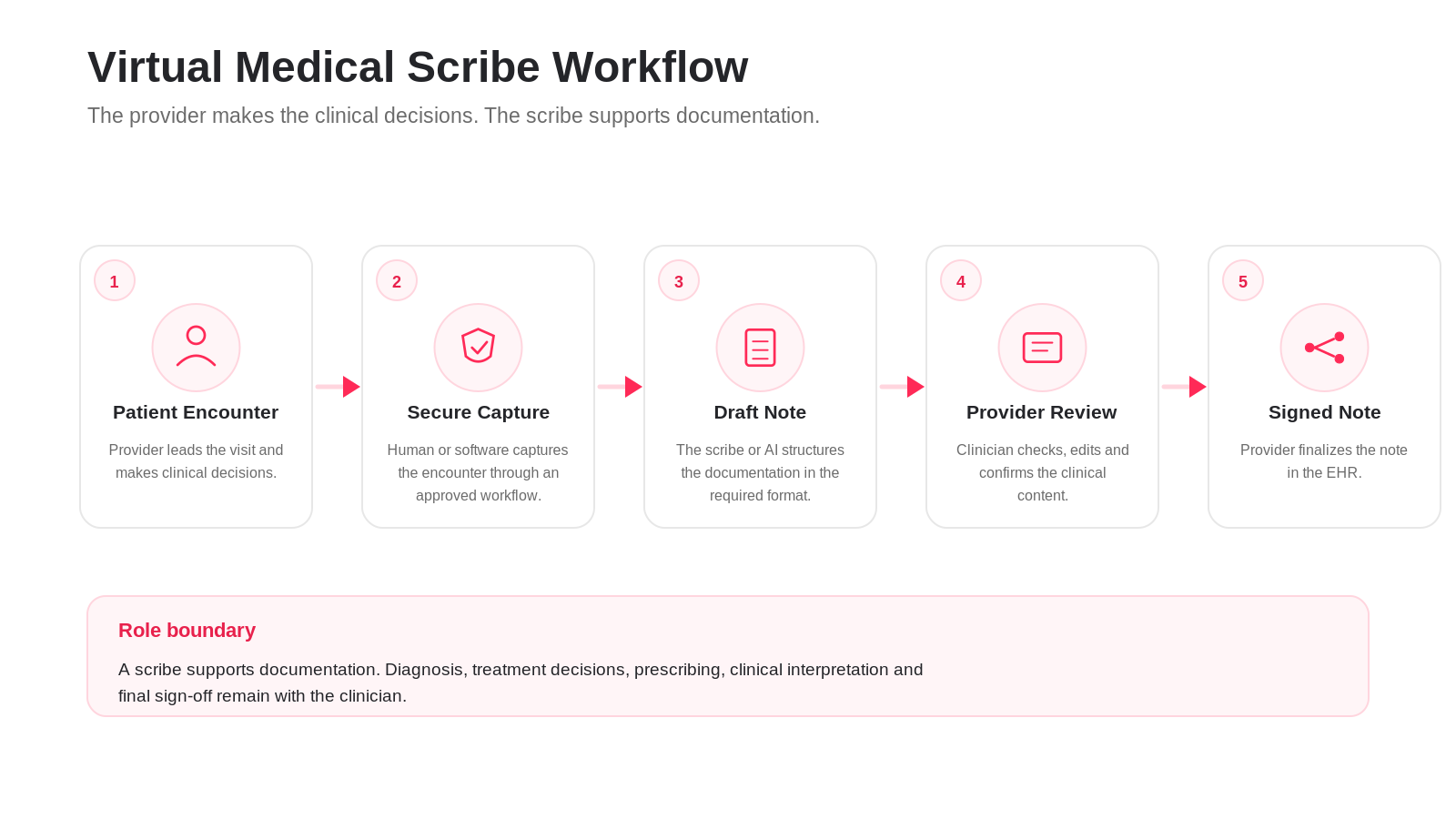
For a fuller explanation of the role, documentation responsibilities, and day-to-day workflow, see our guide to virtual medical scribe services.
Questions to Ask Every Virtual Medical Scribe Company Before You Sign
- Is the service human, hybrid, or AI-only?
- Who produces the first draft of the note?
- Who reviews the note before the clinician sees it?
- Does the service enter data directly into the EHR?
- Is the integration one-way or bi-directional?
- Does the vendor pull patient context from the EHR before the visit?
- Which specialties use the service in production today?
- Can the workflow handle our exact note templates?
- Is documentation real-time, same-visit, or delayed?
- How are corrections and provider preferences learned?
- What happens when a human scribe is unavailable?
- What is the implementation timeline?
- Will the vendor sign the required BAA?
- What PHI is stored, and for how long?
- Are audio recordings retained?
- Is customer data used for model training?
- What encryption, authentication, and access controls are used?
- How does offboarding remove access and credentials?
- Are there minimum hours, licenses, seats, or contract terms?
- What is the total monthly cost after implementation and support?
Final Takeaway
The strongest choice depends less on the brand name than on the documentation model your practice actually needs.
Choose a human-first provider when continuity with a trained person, live charting, and provider-specific workflow learning are the priority. Choose a hybrid provider when you want AI speed with another review layer. Choose ambient AI when software scale, rapid draft generation, and deeper automation matter more than having a named human scribe.
Then narrow the field using EHR integration depth, specialty evidence, note turnaround, clinician review burden, security and BAA terms, backup or uptime expectations, onboarding, and total cost. Those factors create the real difference between products that may all be marketed under the same "virtual medical scribe" label.
Frequently Asked Questions
What are the best virtual medical scribe companies in the USA?
Companies and platforms worth comparing include Virtual Mojoe, ScribeAmerica, Augmedix by Commure, Hello Rache, IKS Health, DeepScribe, Microsoft Dragon DAX Copilot, Abridge, ScribeEMR, and Freed. The right shortlist depends on whether you want a dedicated human scribe, a hybrid service, or ambient AI.
Which virtual medical scribe companies use human scribes?
Virtual Mojoe, ScribeAmerica, and Hello Rache are human-first options in this comparison. ScribeEMR, IKS Health, and Augmedix also offer service levels that include human scribing or human review.
Which companies offer both AI and human medical scribing?
ScribeEMR, IKS Health, and Augmedix by Commure each provide multiple documentation models that combine different levels of automation and human involvement.
Which virtual medical scribe is best for Epic?
Several vendors have strong Epic evidence, but the integration types differ. Abridge has deeply embedded Epic workflows, IKS Health is available through Epic Connection Hub, DeepScribe documents bi-directional Epic integration, and ScribeEMR lists Epic among 45+ supported EMRs. The best choice depends on the care setting, implementation model, and whether you want human or AI scribing.
How much does a virtual medical scribe cost?
Human, hybrid, and AI pricing should not be compared as one category. Hello Rache currently publishes $9.50 per hour for human scribing. Freed publishes AI plans from $39 per month. Most managed staffing, hybrid, and enterprise AI providers require a custom quote.
Is a human virtual scribe better than an AI medical scribe?
Neither model is universally better. Human scribes provide a staffing relationship and can learn a provider's workflow over time. AI scribes can generate notes quickly and scale through software. Hybrid models try to combine AI speed with a human review or service layer.
What EHR features should I compare between medical scribe companies?
Ask whether the service enters notes directly in the EHR, requires copy and paste, supports one-click push, pulls patient context before the visit, maps data into discrete fields, supports your templates, and works with your exact EHR version and care setting.
Do virtual medical scribe companies sign BAAs?
Many vendors in the category offer Business Associate Agreements, but terms vary by product and contract. Confirm the BAA before a vendor receives PHI, and review access controls, retention, incident response, authentication, and offboarding as part of the same security review.
What is the difference between a virtual medical scribe and medical transcription?
Virtual scribing is typically tied directly to the clinical encounter and documentation workflow, often in real time or shortly after the visit. Transcription traditionally converts dictated or recorded audio into text after the fact. Some modern vendors now combine transcription, scribing, ambient AI, and EHR automation under one documentation suite.
How should a specialty practice choose a medical scribe?
Prioritize specialty-specific terminology and note structure, EHR integration, coding and documentation requirements, turnaround time, clinician review burden, security, and evidence that the vendor already supports similar clinical workflows.
AI Summarize