
Healthcare organizations are improving efficiency, reducing administrative workload, and enhancing patient coordination by adopting virtual assistants for healthcare as a key operational strategy in 2026. These solutions streamline workflows, speed up routine tasks and improve overall service delivery.
While healthcare providers use virtual assistants for healthcare to reduce administrative pressure and manage growing patient demands they have now become an essential part of daily operations. They bring speed, accuracy and organization to healthcare workflows, helping teams work more efficiently.
Top 7 Benefits of Virtual Assistants for Healthcare Providers
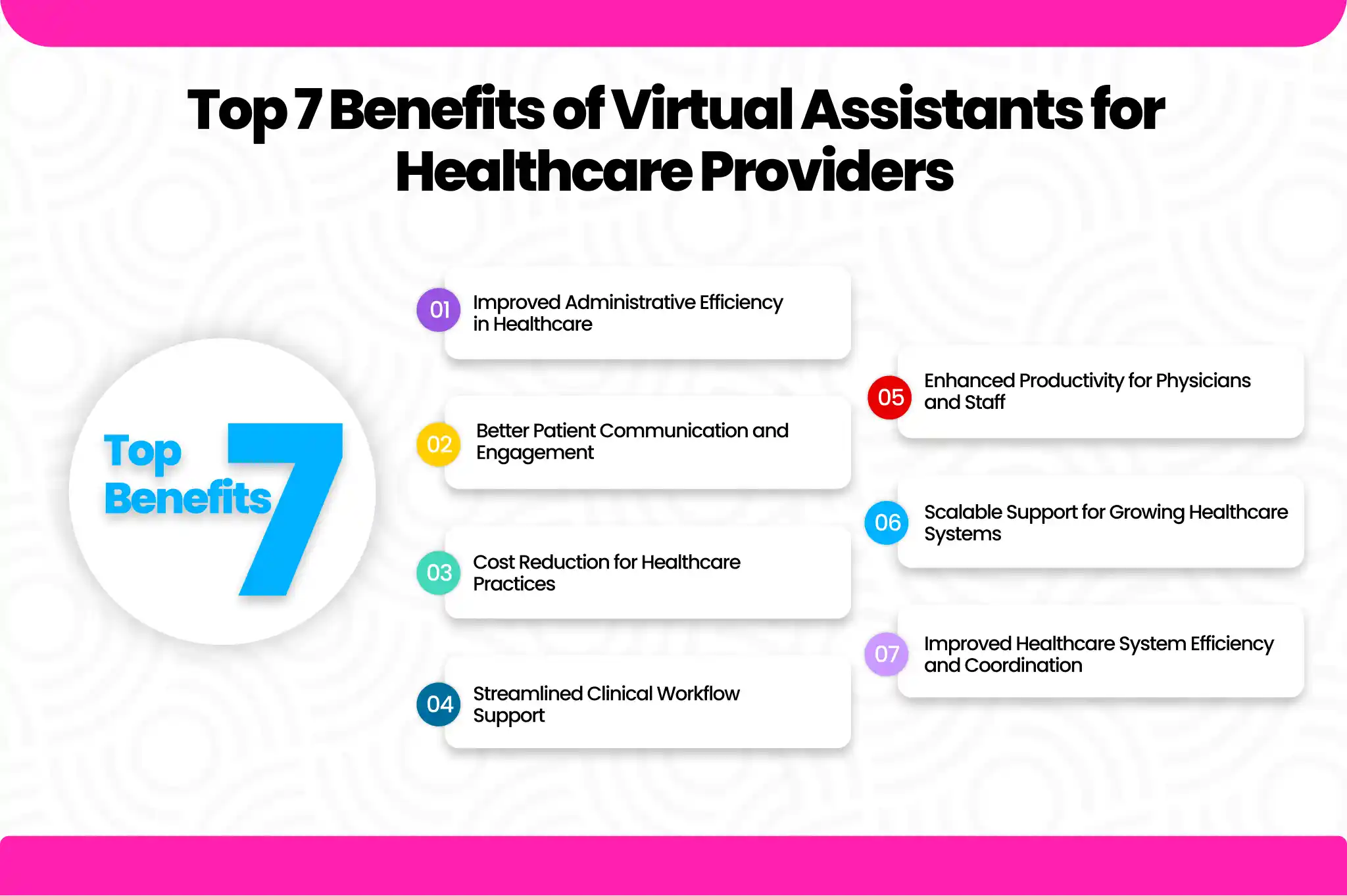
Healthcare systems rely on efficient operations and virtual assistants for healthcare help reduce workload, improve coordination and streamline daily tasks for better overall efficiency.
1. Improved Administrative Efficiency in Healthcare
Virtual assistants significantly reduce the workload of internal staff by handling repetitive and time-intensive administrative tasks that often slow down clinic operations.
Many practices using a virtual assistant for healthcare clinics report smoother scheduling, faster task completion and fewer administrative bottlenecks throughout the day.
Key Improvements
- Appointment scheduling and calendar coordination
- Patient intake and registration support
- Email and inquiry handling
- Data entry and record updates
- Documentation assistance
By delegating these tasks, healthcare teams can operate more efficiently and reduce delays in daily operations.
2. Better Patient Communication and Engagement
A healthcare virtual assistant for doctors ensures that patients receive timely communication and consistent follow-ups which significantly improves overall satisfaction and trust.
Key Improvements
- Faster response to patient inquiries
- Automated reminders for appointments
- Post-visit follow-up communication
- Reduced missed appointments
- Better patient engagement experience
This improves continuity of care and helps healthcare providers maintain stronger patient relationships over time.
3. Cost Reduction for Healthcare Practices
Using a virtual assistant for healthcare professionals is a cost-efficient alternative to hiring full-time administrative staff, especially for small and mid-sized practices.
Key Savings Areas
- Reduced payroll expenses
- Lower training and onboarding costs
- No infrastructure or office overhead
- Flexible hourly or task-based pricing
- Scalable workforce support
This makes virtual assistants a practical solution for practices aiming to optimize budgets without sacrificing efficiency.
4. Streamlined Clinical Workflow Support
A medical virtual assistant plays an important role in supporting clinical operations by managing documentation and assisting healthcare teams with structured workflows.
Key Improvements
- EHR and EMR data entry support
- Medical documentation preparation
- Lab coordination and report tracking
- Patient intake assistance
- Workflow organization and updates
This reduces delays in clinical documentation and improves coordination between staff members.
5. Enhanced Productivity for Physicians and Staff
A virtual assistant for physicians helps doctors focus more on patient care rather than on administrative responsibilities that consume valuable time.
Key Improvements
- Reduced documentation workload
- Increased patient consultation time
- Better time allocation
- Lower stress from administrative tasks
- Improved focus on clinical decisions
This leads to better productivity, improved work-life balance and enhanced patient care quality.
6. Scalable Support for Growing Healthcare Systems
Modern virtual medical assistants offer scalable support models that allow healthcare providers to expand or reduce assistance based on patient volume and operational demand.
Key Improvements
- Flexible staffing capacity
- On-demand workload adjustment
- Seasonal patient handling support
- Multi-task operational assistance
- Easy expansion without hiring delays
This makes virtual assistants ideal for growing clinics and multi-location healthcare organizations.
7. Improved Healthcare System Efficiency and Coordination
A virtual medical assistant improves coordination between administrative staff, clinical teams and patients by ensuring tasks are completed on time and without confusion.
Key Improvements
- Better internal communication
- Reduced scheduling conflicts
- Faster task completion
- Improved workflow consistency
- Stronger operational organization
This results in a more structured and efficient healthcare environment overall.
Why Virtual Assistants Are Becoming Essential in Healthcare
Just like organizations rely on virtual assistants for healthcare to improve operational workflows, healthcare providers are increasingly adopting them to enhance productivity, staff efficiency and patient satisfaction.
The growing use of virtual Assistants in Healthcare reflects a broader shift toward digital transformation, remote staffing models, and automation-driven healthcare systems. Providers are now prioritizing efficiency, coordination and patient experience, not just cost reduction.
This shift is also driven by increasing patient loads, rising documentation requirements, and the need for faster internal communication. As a result, virtual assistants are now seen as a long-term operational solution rather than a temporary support option.
How Virtual Medical Assistant Services Improve Healthcare Operations
The demand for the best virtual medical assistant services for healthcare continues to rise as healthcare organizations look for smarter ways to manage operations without expanding internal teams.
This shift is especially driven by the growing use of virtual assistants for healthcare, which help streamline administrative and clinical workflows more efficiently.
Key Operational Benefits
- Faster completion of routine tasks
- Reduced administrative backlog
- Improved patient coordination systems
- Better workflow visibility and control
- Increased operational consistency
These improvements help healthcare providers maintain smoother daily operations while improving service quality.
The Role of a Virtual Nursing Assistant in Healthcare Support Systems
A virtual nursing assistant plays a more clinically aligned support role compared to general virtual assistants, helping healthcare teams manage nursing-related administrative and patient-care coordination tasks more efficiently. This role is especially valuable in high-volume healthcare environments where nurses are often overloaded with documentation and follow-up responsibilities.
By assisting with non-critical clinical tasks, a virtual nursing assistant helps reduce workload pressure on in-house nursing staff while improving the accuracy and speed of patient-related processes.
Key Responsibilities
- Assisting with patient monitoring updates and follow-ups
- Supporting care plan documentation and updates
- Managing EHR/EMR entries and clinical data support
- Coordinating patient communication with nursing teams
- Assisting in discharge instructions and post-care follow-ups
Conclusion
While healthcare providers often rely on virtual assistants for healthcare to improve operational efficiency these professionals also play a key role in enhancing communication, reducing workload and supporting both administrative and clinical teams more effectively.
The combination of virtual assistants for healthcare and structured healthcare systems creates a more efficient, scalable and patient-focused healthcare environment in 2026. It helps organizations maintain smoother workflows, improve response times, and ensure better coordination across departments, ultimately leading to higher patient satisfaction and stronger overall performance.
FAQs
1. What is a healthcare virtual assistant?
A healthcare virtual assistant supports administrative, clinical and communication tasks remotely for medical practices.
2. How do virtual assistants help doctors?
They reduce administrative workload, manage scheduling and improve patient communication efficiency.
3. Are virtual assistants cost-effective for clinics?
Yes, they reduce staffing and operational costs while improving productivity.
4. Can virtual assistants handle clinical tasks?
They assist with documentation, EHR updates and workflow support but do not replace licensed medical professionals.
5. Why are virtual assistants becoming popular in healthcare?
They improve efficiency, reduce workload pressure and enhance patient experience in modern healthcare systems.